
Golden Pokies Casino Australia: Legal Guide 2026
 Available in AU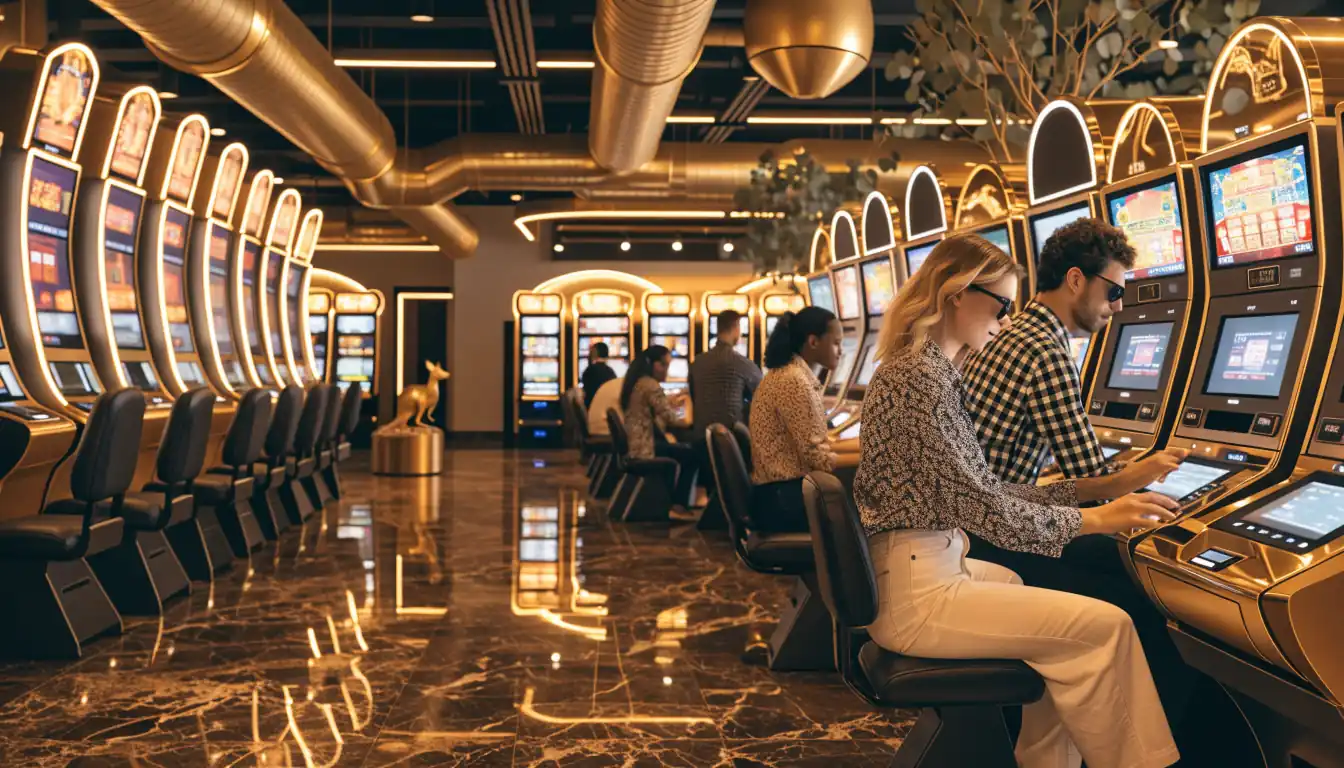
Understanding Pokies in Australia
Pokies — the Australian term for electronic gaming machines, or EGMs — are not a marginal pastime in Australia. They are a structural feature of the country’s hospitality industry, its state budgets and, increasingly, its regulatory debates. Before any discussion of bonuses, deposit codes or online play makes sense, the underlying machine economy deserves a proper look: how many machines there are, where they sit, how much money moves through them, and how the land-based product differs from anything a browser can offer.
The short version of that accounting: in the financial year 2020–2021 alone, Australians placed bets worth almost AUD 150 billion on electronic gaming machines. Total player loss for the same period was about AUD 12 billion. Per capita, that works out to AUD 608 of losses for every person in the country, not every gambler — every person, counted from newborns upward. Those three numbers frame everything that follows in this article, including the sections on legality, laundering risk and promotional compliance.
Machines in every jurisdiction
Electronic gaming machines are operated in all Australian states, the Australian Capital Territory and the Northern Territory. There is no jurisdiction on the mainland where the machines are absent, and none where a pub or club licenceholder has to look far to install them. This national reach matters for two reasons.
Before picking a pokies site to play at in 2026, it helps to know how each operator’s licensing and welcome offer actually stack up so you can judge what’s worth your first deposit.
License: Curacao Gaming Control Board (TechSolutions Group N.V.) · Bonus: 100% up to A$250 + 100 free spins (1st deposit) Licensed under the Curacao Gaming Control Board via TechSolutions Group N.V., this operator welcomes new players with a 100% match up to A$250 plus 100 free spins on the first deposit.
License: Curacao eGaming OGL/2024/923/0383 (Antillephone N.V.) · Bonus: up to A$2,000 + 100 free spins across 2 deposits · Min. deposit: A$30 Holding a Curacao eGaming licence through Antillephone N.V., this casino spreads its welcome bonus of up to A$2,000 plus 100 free spins across two deposits, with a low A$30 minimum deposit to get started.
License: Curacao eGaming (Roby Games Ltd) · Bonus: 100% up to A$750 + 200 free spins Operating under a Curacao eGaming licence via Roby Games Ltd, players can claim a 100% bonus up to A$750 along with 200 free spins.
License: Curacao eGaming OGL/2023/174/0082 (Dama N.V.) · Bonus: up to A$10,000 + 500 free spins across 4 deposits · Min. deposit: A$15 Licensed by Curacao eGaming through Dama N.V., this site offers a substantial welcome package of up to A$10,000 plus 500 free spins spread over four deposits, with an accessible A$15 minimum deposit.
License: Curacao Gaming Control Board · Bonus: up to A$5,000 + 400 free spins Regulated by the Curacao Gaming Control Board, this operator stands out with a generous bonus offer of up to A$5,000 plus 400 free spins.
License: Curacao (operating since 2017) · Bonus: 250% up to A$2,000 + 50 free spins on the first of six deposits · Min. deposit: A$20 Licensed in Curacao and operating since 2017, this established casino offers a 250% bonus up to A$2,000 plus 50 free spins on the first of six deposits, with a A$20 minimum deposit.
License: Curacao Gaming Control Board OGL/2023/174/0082 (Dama N.V.) · Bonus: up to A$5,000 + 300 free spins across 4 deposits Licensed by the Curacao Gaming Control Board via Dama N.V., this operator provides a bonus package of up to A$5,000 plus 300 free spins spread over four deposits.
License: Curacao Gaming Control Board OGL/2023/176/0095 (Hollycorn N.V.) · Bonus: 100% up to A$10,000 + 100 free spins Holding a Curacao Gaming Control Board licence through Hollycorn N.V., this casino offers a notably large 100% bonus up to A$10,000 plus 100 free spins.
Bonus: 100% up to A$750 + 200 free spins, 35x wagering · Payout speed: crypto 30-120 minutes, fiat 24-72 hours · Min. deposit: A$30 This operator offers a 100% bonus up to A$750 plus 200 free spins with 35x wagering, and is notable for fast crypto payouts within 30-120 minutes alongside standard fiat withdrawals of 24-72 hours; a A$30 minimum deposit applies.
Bonus: up to A$7,500 + 550 free spins across 10 deposits, 50x wagering · Payout speed: crypto under 1 hour, PayID 1-3 business days · Min. deposit: A$20 (A$30 to qualify for the bonus) This casino combines a large welcome package of up to A$7,500 plus 550 free spins across ten deposits with quick payout options, including crypto withdrawals under an hour and PayID processing within 1-3 business days.
First, it means the regulatory conversation is never about whether pokies exist, only about how many, where, under what conditions and with what degree of traceability. Second, it means the differences between states are differences of density and policy, not of kind. A venue operator in NSW, a club in Queensland and a casino in the ACT are all running fundamentally the same product, but under separate state-level rules on machine caps, cash handling and, latterly, cashless play.
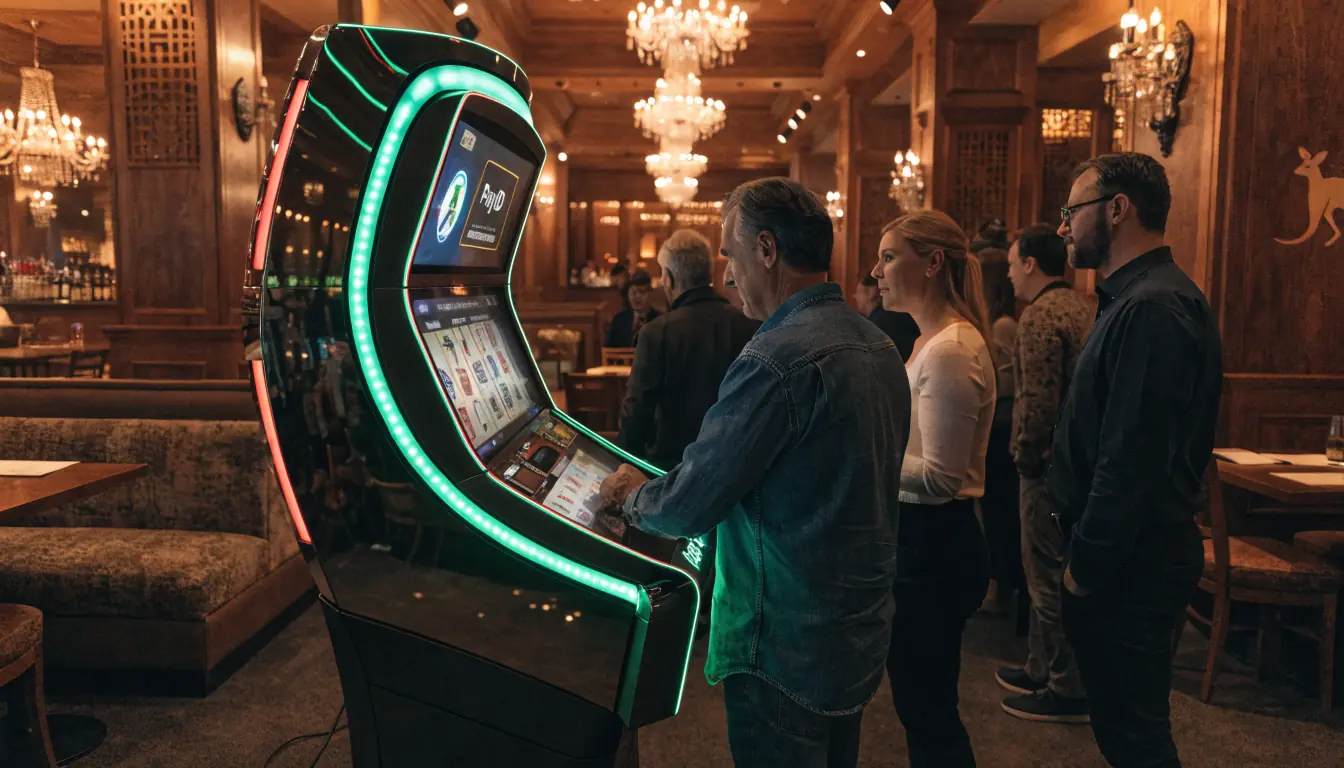
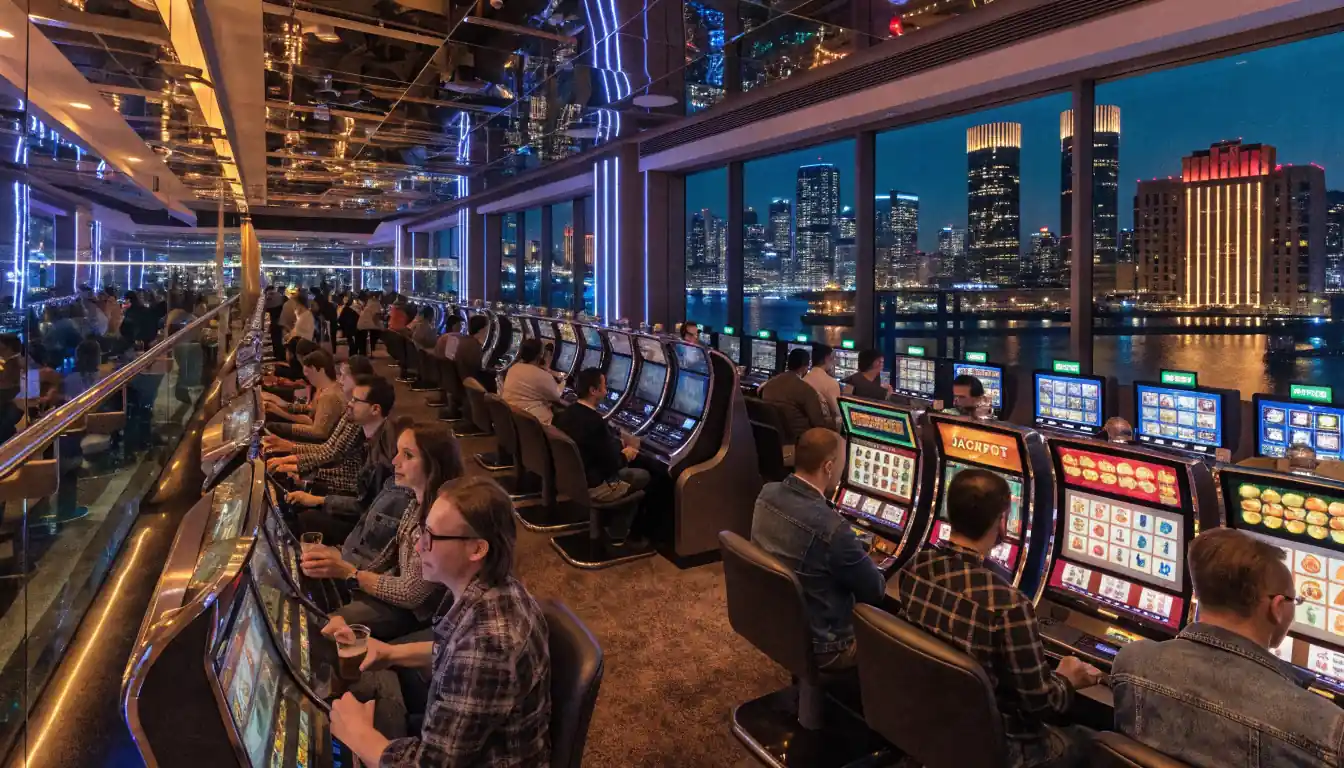
Pokies are widely used in Australian pubs, clubs and casinos — that trio of venues is worth keeping in mind, because the three settings behave very differently:
- Pubs put machines in the path of ordinary social traffic. A drinker does not have to travel anywhere or make a decision to enter a gambling venue; the machines are in the next room.
- Clubs — licensed social and sporting clubs — hold large machine estates and are, in several states, major beneficiaries of gaming revenue, some of it redirected into community and sporting infrastructure.
- Casinos hold the highest concentration of machines per venue and, as a class, carry the heaviest compliance obligations, up to and including the amended Casino Control Act 1992 provisions that allow NSW casino operators to be fined up to AUD 100 million for compliance failures.
The distinction is not cosmetic. When regulators talk about harm, the pub-and-club sector dominates by sheer machine count; when they talk about institutional integrity and laundering, the casino sector takes the foreground. Both conversations are, in different registers, about the same machine.
The numbers: what flows through the machines
Two categories of figure get reported, and conflating them is the most common error in public discussion of gambling economics.
Turnover is the total amount wagered. Player loss — net gambling revenue — is what remains with the house after payouts. The gap between the two is enormous, because money wagered on a machine is typically re-wagered, sometimes many times over, before it is either lost or cashed out.
For the financial year 2020–2021:
| Measure | Figure |
|---|---|
| Total bets placed on EGMs | almost AUD 150 billion |
| Total player loss | about AUD 12 billion |
| Per-capita player loss | AUD 608 |
The per-capita figure deserves a moment of arithmetic discipline. AUD 608 is the average loss across the entire population. The loss is not distributed evenly — it is concentrated among a relatively small group of regular players, which means the actual annual loss of a habitual pokies player is a multiple of the average, while the majority of the population contributes little or nothing. The average is a population statistic, not a description of a typical player.
There is also a more recent figure circulating: according to complyadvantage.com, pokies generated AUD 191.2 billion in gambling turnover in 2023. That is a single-source number for a later period, and it is reported here as exactly that — one outlet’s figure, not an established market benchmark. What it does illustrate, even taken cautiously, is the direction of travel after the pandemic-affected 2020–2021 year: turnover at or above pre-pandemic scale, with losses moving in step.
A discrepancy worth naming
How large is Australia’s share of the world’s poker machines? The honest answer is that published figures disagree, and the disagreement is not trivial.
One commonly cited figure puts Australia at 3% of the world’s pub and club poker machines. Another puts the country at about 18% of the world’s poker machines. Both cannot describe the same thing, and the likely source of the gap is definitional: "pub and club poker machines" is a narrower category than "poker machines" as a whole, which would include casino slot floors internationally. A third of the world’s pub-and-club machines — the 18% figure — versus a single-digit share of all machines everywhere are compatible statements about different denominators, but the sources themselves do not always spell this out.
Rather than silently pick one, it is cleaner to state the range and the lesson it carries: whatever denominator is used, Australia’s concentration of machines outside dedicated casinos — in ordinary pubs and clubs — is internationally unusual. That structural fact, not the precise percentage, is what drives the policy debate.


Where the money goes: operators, states and the tax base
Player losses do not simply vanish into operators’ accounts. Taxation of gambling operators in Australia varies by state and by type of gambling service, and EGM revenue is one of the more heavily taxed lines in the hospitality sector. States set their own rates and structures, which is why the same machine earning the same revenue can deliver materially different net returns depending on which side of a state border it sits on.
This state-level reliance on gaming tax creates a fiscal arrangement that is rarely stated bluntly: state treasuries have a direct budgetary interest in the volume of play on machines whose social costs the same governments are separately obligated to minimise. Regulators and harm-minimisation agencies sit in the same public sector as the revenue offices collecting from machine turnover. The arrangement is not hidden — it is published in budget papers — but it is the background condition against which every reform proposal, including cashless gaming, gets weighed.
One asymmetry completes the picture at the player’s end: gamblers’ winnings in Australia are not taxed. For an individual, a win is not assessable income and a loss is not deductible. The tax burden lands on the operator and, through it, partly on the states. For a professional gambler whose gambling constitutes a business, the treatment can differ — but for the ordinary player at a machine, the arithmetic is simple: what leaves the machine in hand is what the player keeps.
Winnings, losses and the house margin
The untaxed status of winnings is sometimes read as generosity. It is more accurately described as arithmetic consistency. The machine already retains its margin before any payout is made — the AUD 12 billion in player losses is measured after every win was paid. Taxing winnings on top of that would be double-counting the same pool of money at two points in its journey.
What the untaxed-winnings rule does affect is behaviour at the margin: it removes any tax-based reason to under-report wins or over-report losses, which matters for the traceability discussion later in this article, and it means the only real number a player needs to track is net position over time. On a machine, net position over time is negative by design; the house margin is not a matter of luck distribution but of the payout structure itself. Luck decides which individual sessions end ahead. Structure decides the aggregate.
Land-based pokies versus what the browser offers
This is where the difference between the physical product and anything calling itself an online equivalent becomes sharp. A machine in a pub or club is a licensed, physically located, state-regulated device: its game parameters are approved, its venue is inspectable, and its revenue is taxed within Australia. Online pokies aimed at Australian players are a different animal entirely.
The Interactive Gambling Act 2001 makes it an offence for online operators to offer real-money gambling to Australian residents. There are no domestically licensed real-money online casino operators available to Australian players — a licence to run an online casino domestically cannot be obtained. It is not illegal for an individual Australian to play at an offshore-licensed online casino; the law targets operators, not players. But "not illegal for the player" and "regulated for the player" are different claims, and only the first one is true here.
The practical consequences of that gap:
- No local recourse. A dispute with an offshore operator is not a dispute a state regulator will take up. Complaint procedures, where they exist, sit outside any Australian enforcement framework.
- No Australian tax attachment. Offshore turnover generates nothing for Australian state budgets, whatever it generates elsewhere.
- No Australian harm-minimisation settings. Land-based venues operate under state-mandated harm-reduction requirements; an offshore site’s responsible-gambling measures are whatever that jurisdiction — or that operator’s commercial judgement — produces.
The legal mechanics of the Interactive Gambling Act, and what precisely is prohibited versus permitted for online play, are covered in the next section. What belongs here is the structural point: the phrase "online pokies," applied to services available in Australia, describes an unlicensed-by-Australia product by definition. Any comparison of "the same games, but online" is comparing a taxed, inspected device with an offshore service on which none of those conditions run.
Cash, traceability and why machines attract the wrong attention
Electronic gaming machines share one property that shapes both their money-laundering risk and the current reform agenda: the high volume of cash transactions and limited traceability of pokies make them attractive for money laundering. The mechanics of that exploitation — how criminal proceeds move through machines, the red flags AUSTRAC trains operators to watch for, and the compliance obligations attached to machine counts — are the subject of a dedicated section below.
Cash anonymity risk
Cash handling makes pokies a prime target for money‑laundering; operators that fail to address this anonymity can face severe regulatory penalties.
But the underlying property belongs in this overview, because it explains a great deal about the direction of Australian pokies policy. A machine that accepts anonymous cash and pays out on request, in small or large amounts, at thousands of venues nationwide, is a currency-exchange point that happens to include entertainment. Strip the gambling away and what remains is a distributed network for converting cash into receipts. Regulators noticed; the 2024 AUSTRAC guidance on laundering red flags and the NSW moves toward cashless machines are both responses to that property, not to gambling harm in the abstract.
The countervailing development is equally structural: cashless, account-based machine play, which makes deposits, gameplay and withdrawals traceable end-to-end. The NSW Crime Commission’s interest in cashless gaming, and the recommendation that all NSW pokies be cashless by the end of 2028 attributed to the 2022 Islington Report, come from the laundering side of the ledger rather than the harm side. Both roads lead to the same destination: less anonymity at the machine.
Who plays, and how early it starts
Gambling participation in Australia begins earlier than most people assume. Almost one in three Australians aged 12–17 — 30% — gamble in some form. Among 18-year-olds, 46% gamble. The minimum legal gambling age in Australia is 18, which means the adolescent figure measures activity that is, in its regulated forms, unlawful for that age group entirely.
These numbers sit awkwardly beside a product embedded in pubs and clubs — venues that are, for older teenagers at least, socially familiar territory. The youth-participation statistics are about gambling broadly, not pokies specifically; no verified breakdown by game type for underage players is published in the source material. But the pattern they establish — that gambling behaviour is already well established before legal access begins — is a standing challenge to the assumption that age limits alone manage entry into machine play.
The venue economics, spelled out
A pub or club deciding whether to hold machines is doing a straightforward financial calculation. The machine estate generates gaming revenue that in many venues outstrips the core hospitality business. Against that revenue sit state taxes, licensing costs, monitoring obligations and — for operators with more than a handful of machines — an escalating ladder of anti-money-laundering duties: registration with AUSTRAC and record-keeping up to fifteen machines; beyond that threshold, a compliance officer, formal risk assessments, an AML/CFT program, customer due diligence and reporting of cash transactions over AUD 10,000.
Compliance ladder
Operators with more than 15 machines must appoint a compliance officer, conduct risk assessments, implement an AML/CFT program, perform customer due diligence, and report cash transactions over AUD 10,000. Smaller venues have lighter obligations, but all must adhere to the baseline reporting framework.
That ladder is worth noting here, ahead of the detailed compliance section, because it converts a question often framed morally ("should venues profit from pokies?") into an operational one with a defined cost curve. Gaming revenue is not free money for the venue; it arrives attached to obligations whose cost scales with machine count. A venue holding a large estate is running a regulated financial-adjacent business inside its front bar, whether or not it planned to.
Mobile play and the shift in access
The query that brought many readers to this page — golden pokies casino australia 2026 — typically reflects an expectation formed on a phone: casino-style play as an app-like, always-available product. The expectation is understandable, and the product mostly cannot lawfully exist in the form it appears to promise.
What the Australian market actually permits online is wagering: licensed sports and race betting services, operating under state and territory licences, available on mobile. Online casino-style games — pokies above all — sit on the prohibited side of the Interactive Gambling Act. The "mobile pokies casino" that an Australian phone user can reach is, with no domestic alternative existing, an offshore service: legal for the player to use, unlicensed in Australia, and operating entirely outside the compliance, taxation and harm-minimisation framework described above.
The difference between the two experiences is therefore not one of quality or convenience. It is that the licensed, taxed, inspectable version of pokies exists only in physical venues — while the phone-shaped version exists, where it exists, in a regulatory vacuum with respect to Australia. A player choosing the phone is not choosing a channel; they are choosing a jurisdiction.
Reading the market honestly
Strip the marketing language away and the Australian pokies market reduces to a few load-bearing facts:
- Machines operate in every state and territory, concentrated in pubs, clubs and casinos.
- Australians wagered almost AUD 150 billion on EGMs in 2020–2021, losing about AUD 12 billion — AUD 608 per capita.
- Operator taxation varies by state and service type; player winnings are untaxed.
- The machines’ cash handling makes them a laundering vector, and the reform agenda — cashless play, account-based traceability — is converging on that property from both the crime and harm directions.
- The online equivalent of the product has no domestic licence, cannot obtain one, and whatever carries the name online is by definition outside the Australian framework.
Everything else — brand names, bonus terms, deposit codes, app features — is downstream of that structure. The remaining sections of this article take each downstream layer in turn: what the Interactive Gambling Act actually permits and prohibits online, how laundering through machines works and what AUSTRAC requires operators to do about it, and what the bonus-and-code economy looks like when it is governed by rules that operators ignore at the cost of civil penalties and, in NSW casinos, fines of up to AUD 100 million.
The machine itself is simple. The structure around it is not, and that structure is what a player in Australia is actually interacting with — every time a note goes into a slot, and every time a phone screen promises the same thing without the slot.
Online Pokies and Legal Boundaries
The legal position of online pokies in Australia is easier to state than most players expect, because it contains no grey zone where a domestic licence could hide. The Interactive Gambling Act 2001 (IGA) makes it an offence for online operators to offer real-money gambling to Australian residents. Online casino-style games — pokies, poker, blackjack, roulette — fall squarely inside that prohibition, and there is no licence an operator can hold to lawfully provide them domestically. Sports betting and lotteries are licensed and legal; online casinos are not, and cannot be.
Legal status of online pokies
Offering real‑money online pokies to Australian residents is an offence for the operator under the Interactive Gambling Act 2001, while the individual player does not break the law by using an offshore service.
Where the law points
The offence sits with the operator, not the player. It is not illegal for an individual Australian to play at an offshore-licensed online casino — the IGA targets the businesses offering the service, not the people using it. That distinction explains the practical landscape: offshore sites remain reachable from Australia, Australian regulators pursue the providers, and the player breaks no law by spinning the reels.
Two further rules shape the money side of the equation. Winnings from gambling in Australia are not taxed: a payout is not income in the eyes of the tax office, so the player keeps the full amount. Taxation of gambling operators, by contrast, varies by state and by type of gambling service — a patchwork that applies to the licensed end of the market, which offshore casino sites sit outside entirely.
The contrast with land-based machines
Land-based pokies are the mirror image of the online picture. Electronic gaming machines operate legally in every Australian state and territory, in pubs, clubs and casinos, under state-level regulation. A player standing in a licensed club is using a machine that a regulator has approved, in a venue that pays taxes under its state’s scheme, with a complaints pathway behind it.
A player using an offshore online pokies site has none of that scaffolding. No Australian regulator supervises the operator. No local licence exists to be checked, no public register of approved online casino operators exists to consult, and no state revenue office stands behind the payouts. The game on screen may look identical to a machine in a club; the legal frame around it is a different structure altogether.
Names that travel, rules that don’t
Searches for particular titles — golden-themed pokies in all their varieties, from golden century and golden goddess to golden jungle, golden egypt, golden strike, golden jaguar and golden crown-style sites — reflect how these games circulate. What the search results don’t show is a licensing distinction, because for Australian players there isn’t one to find. Whether an offshore site carries a golden crown in its branding or a golden goddess in its lobby, its legal status vis-à-vis Australian residents is the same: offering it here is an offence under the IGA, and holding a Malta or UK licence does not change that, since those licences cover their own jurisdictions and carry no standing in Australia.
There is also no reliable public data on which providers or specific titles sit behind these offshore lobbies for Australian traffic. Operators in this space do not publish that information in a form anyone can verify, and no Australian regulator collects it, because the activity itself sits outside the regulated market.
What this means in practice
The workable summary runs in four lines. Online pokies offered to Australian residents are prohibited, with no domestic licence available and no path to one. Playing at an offshore site is not an offence for the individual. Land-based pokies in licensed venues are legal, taxed, and state-regulated. Winnings, wherever they come from, are not taxed in the player’s hands.
Anyone comparing the two environments on convenience alone is comparing half the picture. The club machine comes with a regulator, a tax scheme and a complaints process attached; the offshore site comes with a game and little else that Australian law recognises. That asymmetry is not a marketing claim in either direction — it is simply the structure the Interactive Gambling Act built, and it has held for over two decades without a domestic online casino licence ever being created to soften it.

Money‑Laundering Risks and Real‑Money Play
Real‑money pokies occupy a specific place in Australia’s anti‑money‑laundering landscape. The mechanics are simple enough to be the problem: cash goes in, a ticket or a payout comes out, and the record of how that money was earned is now a record of gambling winnings. Criminals insert large sums into electronic gaming machines, gamble minimally, and cash out immediately — the resulting receipt presents illicit funds as legitimate winnings. A related scheme involves offenders buying winning tickets from genuine players, converting untraceable cash into clean, documented funds.
The scale of the sector makes this more than a theoretical concern. Pokies operate across pubs, clubs and casinos in every Australian state and territory, and the volume of cash moving through them — combined with the limited traceability of machine play — is precisely what makes them attractive for laundering. Complyadvantage.com reports that money mules are recruited specifically to launder money through pokies, an arrangement where a third party runs the cash through machines on behalf of someone else in exchange for a cut. That is a reported pattern, not an industry standard, but the underlying logic holds regardless of frequency.
Red‑flag indicators
AUSTRAC issued a guide in 2024 to help firms recognise money‑laundering red flags. The indicators it covers include:
- unusually high cash access and large deposits;
- cash transfers and casino disbursement checks;
- certain occupations flagged as elevated risk.
Machine‑level behaviour matters as much as the cash itself. The patterns that draw scrutiny include:
- large or repeated cash insertions followed by minimal play and an immediate cash‑out;
- frequent small redemptions spread across different venues within a short period — structuring, designed to stay under reporting thresholds;
- customers refusing to provide identification, or using multiple player cards to obscure a single person’s activity.
None of these indicators proves anything on its own. Together, they form the pattern that a venue’s compliance program is required to detect and report.
What the obligations actually require
The regulatory burden falls on operators, and it scales with venue size. Operators with more than 15 pokies must appoint a compliance officer, conduct risk assessments, implement an AML/CFT program, perform customer due diligence on customers, and report cash transactions over AUD 10,000. Smaller venues carry lighter requirements, but no venue sits outside the framework entirely — the reporting obligations apply across the board, which is the point of a threshold system.
For the player, the position is different. Playing real‑money pokies is not, in itself, an AML matter, and a player who cashes out a legitimate win has done nothing reportable about their own conduct. The obligations bind the venue, not the person at the machine. What players do encounter is the consequence of those obligations: identification requests at thresholds, tracking of cash‑out behaviour, and venue staff empowered to escalate unusual patterns.
Regulators have pushed in one consistent direction: tighter customer due diligence, transaction monitoring, and the adoption of cashless gaming systems. Account‑based play leaves a record of deposits, gameplay and withdrawals — the traceability that cash handling removes by design. Facctum.com presents the adoption of cashless, account‑based pokies as improving traceability and reducing anonymity, and the NSW Crime Commission has made the same argument in the context of criminal proceeds moving through venues.
The structural trade‑off is straightforward. Cash is anonymous; accounts are not. Every money‑laundering technique described above depends on the gap between those two states, and each obligation in the AUSTRAC framework exists to close it from the operator’s side.

Bonuses, Deposit Codes and Compliance Requirements
Search interest in sign-up bonuses, no-deposit bonus codes and free chips for online pokies is persistent, so it is worth separating what such promotions actually are from what the legal framework allows.
A no-deposit bonus code, in its common form, is a redeemable string attached to an account at registration or later, intended to unlock play credit without an initial transfer. A sign-up bonus is typically tied to a first deposit, with the code applying a stated condition to that transaction. "Free chips" usually describes the same mechanism under a different label. The specifics — amounts, eligibility, withdrawal conditions — are set by each operator, and no verified, comparable data on current offers for Australian players exists in official sources. Any page publishing exact figures without naming where they come from is guessing.
There is also a structural problem: real-money online casino play cannot be offered to Australian residents under the Interactive Gambling Act 2001, and there is no domestic licence an online pokies operator could hold. A bonus code circulating for such a site is an offer from an offshore operator outside the local regulatory perimeter — whatever its terms state, there is no local regulator to enforce them.
Where land-based pokies are concerned, the compliance side is documented and strict. Operators who fail to meet their obligations face remedial directions, infringement notices and civil fines, along with reputational damage. Regulators recommend tighter customer due diligence, transaction monitoring and cashless gaming systems — measures that make bonus-driven promotional activity easier to audit and cash flows harder to disguise.
For players, one point is practical: winnings in Australia are not taxed, so a bonus code’s appeal rests entirely on its stated conditions. Read those conditions before the code is entered, not after. If an operator does not publish its terms clearly, that absence is itself the answer.
What is the role of the Australian Ad Observatory in monitoring online gambling ads?
The provided text does not contain information regarding the Australian Ad Observatory or its specific functions in monitoring online gambling advertisements.
What security features must licensed casinos have?
While casinos carry heavy compliance obligations, the provided text focuses on general anti-money laundering (AML) requirements like cash transaction reporting and customer due diligence rather than specifying technical security features.
What are the typical withdrawal times for crypto casinos?
The provided text does not contain information regarding cryptocurrency casinos or their specific withdrawal processing times.
What is the regulatory scope of Anjouan Gaming?
The provided text focuses on Australian domestic regulation and does not contain information regarding the regulatory scope of Anjouan Gaming.
Written by the editors at Casino Payment Info.