Best Pokie Machine to Play in Australia: A 2026 Guide
 Available in AU
- What are Pokies and How They Shape the Australian Gaming Landscape
- Online Pokie Games: Availability and Regulatory Restrictions
- Physical Pokie Machines: From Traditional Cabinets to Cashless Systems
- Free Pokie Play: Demo Modes and Their Role for Players
- Pokie Machine Odds and Expected Returns: What the Numbers Show
- Pokies in Australian Casinos and Venues: Market Share and Future Plans
- Game Variety and Betting Activity on Pokies
- Playing Pokies for Real Money: Taxation and Legal Considerations
- Pokie Apps, APIs and Integration: Technology Behind the Slots
- Understanding RTP and Practical Tips for Pokie Players
What are Pokies and How They Shape the Australian Gaming Landscape
"Pokies" is the Australian shorthand for poker machines — the electronic gaming machines (EGMs) that sit in rows along the walls of pubs, clubs and casinos across the country. Elsewhere in the world the same hardware is called slot machines or fruit machines; in Australia the local term has held since the machines first appeared, and it is the word used in legislation, media reporting and everyday conversation alike. The formal name in regulatory documents is "electronic gaming machine," and the two terms refer to the same thing: a cabinet with a screen, a credit meter and a game whose outcome is determined by an internal random number generator.
What the machine actually is
A pokie is a game of pure chance. The player inserts money or loads credits, chooses a stake per spin, and the machine draws a random result. Winning combinations pay back into the credit meter; losing spins do not. There is no skill component in the base game, no decision that changes the long-run result, and no strategy that alters what the machine returns. The return is fixed by the machine’s configuration — a point that matters for anyone comparing a pokie machine payout percentage across venues, and a subject examined later in this article in detail.
Choosing where to spin pokies in 2026 comes down to licensing, bonus value, and how quickly you can access your winnings, so it helps to see how each option stacks up on these essentials before you sign up.
License: Curacao Gaming Control Board (TechSolutions Group N.V.) · Bonus: 100% up to A$250 + 100 free spins (1st deposit) Licensed under the Curacao Gaming Control Board, this casino offers a straightforward first-deposit bonus combining a percentage match with free spins for new players.
License: Curacao eGaming OGL/2024/923/0383 (Antillephone N.V.) · Bonus: up to A$2,000 + 100 free spins across 2 deposits · Min. deposit: A$30 Operating under a Curacao eGaming license, it spreads its bonus value across two deposits and keeps the entry deposit accessible for newcomers.
License: Curacao eGaming (Roby Games Ltd) · Bonus: 100% up to A$750 + 200 free spins Licensed via Curacao eGaming, this casino pairs a solid deposit match with a generous batch of free spins for those getting started.
License: Curacao eGaming OGL/2023/174/0082 (Dama N.V.) · Bonus: up to A$10,000 + 500 free spins across 4 deposits · Min. deposit: A$15 Holding a Curacao eGaming license, it stands out for a large welcome package spread across four deposits and a low minimum deposit requirement, making it easy to unlock the offer.
License: Curacao Gaming Control Board · Bonus: up to A$5,000 + 400 free spins Licensed by the Curacao Gaming Control Board, this casino backs its welcome offer with a sizeable bonus and free spins package.
License: Curacao (operating since 2017) · Bonus: 250% up to A$2,000 + 50 free spins on the first of six deposits · Min. deposit: A$20 A long-running Curacao-licensed operator since 2017, offering a high-percentage bonus on the first of a six-deposit sequence with an accessible minimum deposit.
License: Curacao Gaming Control Board OGL/2023/174/0082 (Dama N.V.) · Bonus: up to A$5,000 + 300 free spins across 4 deposits Licensed under the Curacao Gaming Control Board, this casino spreads a substantial bonus and free spins offer across multiple deposits.
License: Curacao Gaming Control Board OGL/2023/176/0095 (Hollycorn N.V.) · Bonus: 100% up to A$10,000 + 100 free spins Operating under a Curacao Gaming Control Board license, it offers one of the larger single-deposit match bonuses along with a modest free spins add-on.
Bonus: 100% up to A$750 + 200 free spins, 35x wagering · Payout speed: crypto 30-120 minutes, fiat 24-72 hours · Min. deposit: A$30 Notable for fast crypto payouts alongside standard fiat processing times, this casino also runs a deposit bonus with clearly defined wagering terms and a low entry deposit.
Bonus: up to A$7,500 + 550 free spins across 10 deposits, 50x wagering · Payout speed: crypto under 1 hour, PayID 1-3 business days · Min. deposit: A$20 (A$30 to qualify for the bonus) Offers an extensive multi-deposit bonus structure with defined wagering requirements, plus quick crypto withdrawals and PayID processing for Australian players.
The game content has moved far from the original mechanical reels. A modern pokie machine is a networked computer terminal: themed video games with multiple reels, bonus rounds, free-spin features and progressive jackpots linked across venues. New pokie machine titles are released by game studios on a rolling basis and installed on cabinets that can run more than one game, so the machine in a club today bears little resemblance to the single-game cabinet of earlier decades. That hardware shift — from coin-fed boxes to account-based, cashless terminals — is covered in its own section further on.
Where the machines are
The defining feature of the Australian landscape is not the machine itself but where it sits. In most countries, gaming machines are confined to casinos. In Australia they are operated in all six states, the Australian Capital Territory and the Northern Territory, and the majority are not in casinos at all — they are in suburban pubs and licensed clubs. The local RSL club, the sports club, the hotel bistro: these are the venues where most of the country’s pokies are located, which puts the machines within a short drive of a large share of the population. Pokies are widely used in Australian pubs, clubs and casinos; the pub and club segment is the volume driver.
This placement is deliberate policy and licensing history rather than accident. States license venues to operate machines, the revenue from that operation funds the venues and the state budget alike, and the result is a distribution of gaming machines that has no real parallel elsewhere. Australia accounts for 3% of the world’s pub and club poker machines on one count, while another estimate puts the country at about 18% of the world’s poker machines overall — the two figures measure different things, sources disagree, and neither should be quoted as settled fact. What is not in dispute is the direction of the comparison: for a country of this population, the installed base of machines is exceptionally large, and the machines are unusually embedded in ordinary social venues.

Why this matters for everything that follows
The scale and placement of pokies shape every practical question a player asks about them.
The question of "best" is a question of configuration, not venue. When people search for the best pokie machine to play, they are usually looking for the machine that returns the most. But the machines are configured and audited under state regulation, and the differences between individual machines and venues are a matter of configuration data that official sources do not publish in a form that ranks one title against another. What can be said precisely — the statistical picture of losses, turnover and per-capita impact — is set out in a later section with the numbers that are actually on record.
The question of playing online has a different answer than on most markets. The same games that run on venue cabinets exist as online pokie machine games, and the search behaviour around "pokies machine online" is heavy. But the legal position in Australia for real-money online play is not the same as for the machines in the local club, and that distinction — what is available, what is prohibited, and for whom — is treated in the next section rather than glossed here.
Free play exists in a different category. Demo versions and free pokie machine games are also part of the landscape, and they serve a specific function for players who want to see a game’s mechanics without staking money. Their legal status and practical value are covered separately.
Gambling on pokies can lead to significant financial loss; players should only spend money they can afford to lose.
The money volume is a fact, not a feeling. Australians placed bets worth almost AUD 150 billion on electronic gaming machines in the 2020–2021 financial year, and the total player loss for that year was about AUD 12 billion — roughly AUD 608 per capita. Those figures are examined in context later; what they establish here is the baseline. Pokie play in Australia is not a niche pastime. It is one of the largest channels of consumer spending in the country, run through machines that sit next to the bar.
The base layer
Everything else in this article builds on the four facts established above: the machines are electronic gaming machines, chance-based, with returns set by configuration; they operate in every state and territory; they are concentrated in pubs and clubs rather than casinos; and the volume of money moving through them is measured in the tens of billions. Regulatory instruments — the Interactive Gambling Act 2001 for the online side, state licensing for the physical side, AUSTRAC rules for the money that moves through the machines — attach to that base, and each is dealt with where it applies.
The short version: a pokie is a configured random-number machine, Australia has more of them in more ordinary places than almost any comparable country, and every question worth asking about them — payouts, odds, legality, tax, the shift to cashless — is downstream of those two conditions. The sections that follow take those questions one at a time, with the numbers that exist on the record and an explicit note where they do not.
Online Pokie Games: Availability and Regulatory Restrictions
An online pokie game is, at its core, the same product as the cabinet in a pub or a club: a digital slot built around spinning reels, symbol combinations and paylines — the lines across which matching symbols must land for a payout to register. What changes online is not the game logic but everything around it. A digital pokie runs in a browser or an app, is maintained remotely by its provider, and can be updated without anyone touching a machine. The reels, the bet sizes, the number of paylines and the bonus rounds are all software; the cabinet is optional.
That distinction — software versus hardware — is exactly where Australian law draws its line, and the line is not where most visitors expect it.
What the Interactive Gambling Act Actually Prohibits
The Interactive Gambling Act 2001 (IGA) makes it an offence for online operators to offer real-money gambling to Australian residents. Online casino-style games — including pokies, poker, blackjack and roulette — fall squarely inside that prohibition. The law targets the supply side: the operator who provides the service, not the person who plays it. It is not illegal for an individual Australian to play at an offshore-licensed online casino, and no Australian has been prosecuted for spinning reels on a foreign website. The offence sits with whoever offers the product.
A consequence follows that shapes the entire local market: there are no domestically licensed real-money online casino operators available to Australian players, and it is not possible to obtain a licence to operate an online casino domestically. The licence that players in many other countries are told to check for simply does not exist here. There is no local register of licensed online pokie operators, because there is nothing to register. Anyone suggesting a list of "licensed online pokies for Australians" is describing a product that Australian law does not permit anyone to sell.
Illegal Online Offer
It is an offence for any operator to offer real‑money pokie games to Australian residents under the Interactive Gambling Act 2001.
Sports betting and lotteries are licensed and legal online under state and territory arrangements. Casino games are not. A punter can legally place a bet on a race from a phone but cannot legally be offered a real-money pokie by any operator, domestic or foreign — the former is regulated, the latter prohibited.
The Offshore Question
If the IGA makes offering real-money pokies an offence, why do online pokie machines remain one click away? Because the offence is committed by the operator, and the operators that serve the Australian market are incorporated in jurisdictions where their activity is licensed. The Interactive Gambling Act binds operators, not the offshore licensing bodies that authorise them, and enforcement against companies registered abroad has limited reach.
The practical result is a split market:
- What is legal: playing at offshore sites is not an offence for the player. Sports betting and lotteries with Australian licences operate openly.
- What is prohibited: offering online pokies and other casino games to Australian residents. No Australian licence for that product exists.
- What is enforced: the Australian Communications and Media Authority (ACMA) works to disrupt prohibited gambling services, including through blocking and enforcement action against prohibited sites.
This position has a certain arithmetic to it. A law that criminalises supply but not demand leaves demand intact; the demand simply routes around the border. It is not a loophole — it is the design, written into the statute.
How Online Pokies Differ From the Machines in the Venue
The physical pokie machine and its online counterpart are the same game in different packaging, but the packaging carries consequences.
A venue machine sits inside a regulated environment. It is installed under state and territory rules, its location is known, and the venue around it carries obligations — identity checks, cash thresholds, reporting requirements. An online pokie machine, where it operates legally in other countries, runs under that country’s regulator instead: the Malta Gaming Authority or the UK Gambling Commission in the examples most often cited. The player’s protection depends on which regulator, if any, is actually watching. On an unlicensed site, none is.
Free online pokie games occupy separate ground again. Demo versions and simulators — the browser-based replicas of pokie machines that let a player spin without staking anything — do not involve real money at all, and that is what keeps them outside the gambling framework. A free online pokie machine simulator with play-money credits is a game in the ordinary sense: no wager, no payout, no offence. The line between a simulator and a real-money pokie is not the graphics or the paylines; it is whether money can be lost. That distinction, and what free-play versions are actually for, is covered in a later section.
Paylines, Reels and the Mechanics That Travel Across Formats
Because an online pokie is the same software product as its venue counterpart, the mechanics translate directly. Paylines — the set patterns across the reels on which matching symbols pay out — are a property of the game’s design, not of the cabinet. A five-reel game with a given number of paylines behaves the same way whether those reels are rendered on a screen in a club or in a browser window. Bet-per-line multiplied by active lines gives the total stake; the game’s paytable sets out what each combination returns.
What online play adds is configuration freedom. A digital title can ship with more paylines, more bonus features and more themes than a cabinet economy supports, since distribution costs nothing physically. What it does not add is better odds — the return of a pokie is set by its design and, in the physical Australian market, by the regulatory framework around the machine. Software makes the game prettier and easier to reach; it does not change the arithmetic of the game itself.
Online pokie games use the exact same software algorithms, paylines and RTP as their physical counterparts; only the delivery platform differs.
A Note on Winnings
One point where Australia is friendlier than most jurisdictions: gamblers’ winnings are not taxed. A win on a pokie — online or in a venue — is not treated as income, so the player keeps the full amount. Taxation falls on operators instead, and it varies by state and by type of gambling service. The details of that arrangement belong to a later section; the relevant point here is that the tax question is not a reason to prefer one format over another, since the treatment of the player’s winnings does not depend on where the reels happened to spin.
The Honest Summary
The market for online pokie games in Australia is defined by an absence. Real-money play cannot be legally offered to residents, cannot be licensed domestically, and exists online only through offshore operators acting outside Australian authorisation — lawfully as far as the player is concerned, but without the protections a domestic licence would carry. Free versions, simulators and demo modes sit outside this restriction entirely, since no money changes hands. The venue machine, meanwhile, remains the only format of pokie play that operates inside a complete Australian regulatory framework — which is precisely what the next section examines.
Physical Pokie Machines: From Traditional Cabinets to Cashless Systems
A physical pokie machine is, at its core, a purpose-built cabinet: a screen or set of mechanical reels, a coin and note acceptor, a payout mechanism, and a control system that runs the game software and records every credit inserted, wagered and paid out. The classic cabinet design has changed less than the transactions around it. What has changed — and what now drives the cost and compliance profile of every installation — is how money moves in and out of the machine.
The traditional cabinet and its cash economy
For decades, a pokie machine operated as a cash-in, cash-out device. Players fed notes and coins directly into the acceptor, played, and collected winnings in cash or via a ticket redeemed at the venue. That design kept hardware simple, but it also produced exactly the environment regulators now scrutinise: high volumes of physical cash, limited traceability of who played and how much, and no durable link between a deposit and a withdrawal.
The cash-based cabinet is not a historical artefact. It still accounts for a large share of machines in pubs and clubs across Australia. But the direction of travel is clear, and it is regulatory rather than commercial in origin.
Account-based and cashless systems
The modern alternative is the account-based machine. Instead of anonymous cash, the player loads funds into an account tied to verified identity, plays against that balance, and withdraws winnings back to the same account. Transparent, account-based pokies provide full traceability of deposits, gameplay and withdrawals — every transaction carries a name, a time and an amount.
According to facctum.com, the adoption of cashless, account-based pokies improves traceability and reduces anonymity. That is the entire regulatory argument for the transition in one sentence. Where the old cabinet produced a stream of unattributed cash, the account-based machine produces a ledger. For venues, this changes the machine from a standalone gambling device into a node in a monitored financial system — with all the obligations that follow.
The compliance obligations attached to modern installations
Those obligations are not optional, and their scale depends on the size of the installation.
Operators with up to 15 pokies must:
- register with AUSTRAC;
- keep identification records;
- submit suspicious matter reports.
Operators with more than 15 pokies face a heavier list. They must:
- appoint a compliance officer;
- conduct risk assessments;
- implement AML/CFT programs;
- perform customer due diligence;
- report cash transactions over AUD 10,000.
The AUD 10,000 threshold is worth noting for what it implies: the reporting obligation exists precisely because large cash movements through machines were, and remain, a laundering vector. A venue that moves to account-based systems reduces its exposure to that risk mechanically — the traceability is built into the product rather than bolted on through reporting procedures.
The consequences of non-compliance are enumerated rather than vague: remedial directions, infringement notices, civil fines and reputational damage. A compliance failure is therefore a quantifiable business cost, not a theoretical risk.
What this means for machines themselves
For anyone evaluating a physical machine — whether as a venue operator or out of simple interest in the hardware — the purchase price of the cabinet is now the smaller part of the calculation. A traditional cash cabinet carries the ongoing administrative burden of identification records and suspicious matter reporting. An account-based installation shifts the burden into systems: identity verification, transaction monitoring and the AML/CFT program a larger operator must maintain.
Traditional machine that accepts anonymous cash, requires manual cash handling and generates higher AML reporting obligations.
Loads funds onto a player‑linked account, provides full transaction traceability and reduces compliance burden.
Allows both cash and account play, giving venues flexibility while still improving data capture compared with pure cash.
There is no published figure for what a pokie machine costs in Australia, and no reliable retail price list exists for the cabinets themselves — the market operates through suppliers to licensed venues rather than open sale. What can be stated with confidence is the structure of the trade-off: the cheaper, anonymous machine generates the costliest compliance exposure, and the traceable machine converts that exposure into data. Regulators have already stated which side of that trade they prefer, recommending tighter customer due diligence, transaction monitoring and the adoption of cashless gaming systems.
Free Pokie Play: Demo Modes and Their Role for Players
Demo modes are exactly what the name suggests: versions of pokie games that run on the same software, the same reels and the same themes as the paid versions, but with no money on the line. Credits are virtual, spins cost nothing, and any balance accumulated during the session cannot be withdrawn. The machine behaves identically — same reel behaviour, same symbols, same features — which is the entire point of the exercise.
What a demo version actually shows
A free-play build of a pokie game answers a narrow set of questions. Which themes does this title use, how do the bonus rounds trigger, how many reels are in play, and what does the pacing feel like over a session. It is a preview of the product, not a rehearsal of the outcome: the transition from virtual credits to real wagers changes nothing about the game itself, but it changes everything about what the session costs.

What a demo cannot do is build a working strategy. Pokie outcomes are generated independently on each spin; there is no sequence to learn, no pattern to exploit, and no amount of free practice that transfers to the paid version as an advantage. Any product marketed as a "pokie machine strategy" that promises more than entertainment value is selling arithmetic that does not exist. Demo play is useful for deciding whether a game’s themes and mechanics are worth spending money on at a venue — nothing beyond that.
The legal position in Australia
The legal framework draws a clear line between free and paid play. Under the Interactive Gambling Act 2001, it is an offence for online operators to offer real-money gambling — casino-style games including pokies — to Australian residents. Demo versions sit on the other side of that line: because no money is wagered and no winnings can be collected, they do not constitute gambling under the Act.
This produces a situation worth stating plainly. An Australian resident can access free-play versions of pokie titles online without breaking any law, and the Act does not target individual players in any case — it targets operators. What is not available domestically is a licensed pathway to real-money online pokies: no such licence exists, and no operator can legally offer the paid version of the same game to an Australian resident. The free version is legal precisely because nothing is at stake; the paid version is prohibited online precisely because something is.
Free demo versions of pokie games contain no wagering component and are therefore legal for Australian residents to use.
For completeness on the money side: winnings from gambling in Australia are not taxed for players. That applies to real-money play at licensed venues, and it is a separate matter from the legality of how the game was accessed. The distinction between free and paid play is about access and operator obligations, not about the tax treatment of a result — there is no taxable "result" in a demo mode to begin with, since virtual credits have no value.
Free play versus real money: the practical differences
| Demo mode | Real-money play | |
|---|---|---|
| Cost per spin | None — virtual credits | Cash inserted or account debited |
| Withdrawable winnings | No — credits have no value | Yes, subject to venue processes |
| Availability online | Not restricted as gambling | Prohibited for Australian residents under the IGA 2001 |
| Learning value | Themes, reels, feature mechanics | None gained beyond the demo — outcomes are independent |
| Losses | Impossible by definition | The statistical expectation of the game |
The last row is the one that demo modes most effectively obscure. A free session presents a game at its most flattering: unlimited credits, zero consequence, unlimited retries. The paid version runs the same software with the house edge fully engaged. Demo play therefore has one honest role — product evaluation — and one dishonest use, which is as a rehearsal that implies the real session will go the same way. It will not, and no amount of free spins changes the arithmetic.
Where free play fits
For a player weighing up which pokie machine to play, the demo version is a screening tool: it settles whether the themes, reel layout and bonus features hold attention before any money is committed at a venue. Used that way, it saves the cost of discovering a dislike on a paid machine. Used as a training ground for a system, it wastes time on a premise the software does not support.
The absence of a domestic real-money online option also means free play is, for many Australians, the only online form of these games they will encounter. That is the current arrangement of the market, set by the Interactive Gambling Act 2001, and it is unlikely to read differently in 2026.
Pokie Machine Odds and Expected Returns: What the Numbers Show
The headline figure
In the 2020–2021 financial year, Australians lost about AUD 12 billion on electronic gaming machines. That is not turnover — the total amount pushed through the machines — but the amount kept by venues after payouts. Per capita, the loss works out to AUD 608 for every adult in the country. These are actual, recorded figures for a single financial year, not projections or survey estimates.
Turnover versus loss
Turnover and loss are routinely confused, and the difference matters. Turnover counts every dollar wagered, including money that is re-wagered after a win. Complyadvantage.com reports that pokies generated AUD 191.2 billion in gambling turnover in 2023. That figure comes from a single source and is reported as-is here; it has not been corroborated by official statistics cited elsewhere in this article. What is corroborated: in FY 2020–2021, Australians placed bets worth almost AUD 150 billion on electronic gaming machines, and lost about AUD 12 billion of that.
The arithmetic is straightforward. The overwhelming majority of everything wagered on pokies returns to players in the short run, but the aggregate loss across the country is still measured in billions per year — because the volume of play is enormous, not because each session ends in a wipeout.
What the per-capita number actually means
The AUD 608 per-capita loss is an average across the adult population, not a typical individual result. Most adults play rarely or never, which means the loss is concentrated among a smaller group of regular players. An average that includes millions of non-players still landing at AUD 608 per head indicates that losses among active players are substantially heavier than the headline figure suggests.
No "best machine to win"
Searches for the best pokie machine to win reflect a persistent assumption that some machines are beatable. The national loss figures are the aggregate answer to that question: whatever machine is chosen, whatever strategy is applied, the combined outcome across millions of players and billions of dollars in bets is a loss of about AUD 12 billion a year. Individual machines differ in presentation — themes, sounds, betting structures — but the financial outcome at the population level is fixed and negative. The nearest factual approach to "how to play" is understanding the odds rather than expecting to outperform them.
The odds in one line
The numbers do not describe a game some players win overall. They describe a wagering system in which AUD 150 billion in bets produced AUD 12 billion in player losses in a single financial year — and that is the market working exactly as designed.
Pokies in Australian Casinos and Venues: Market Share and Future Plans
Electronic gaming machines operate in every Australian state, the Australian Capital Territory and the Northern Territory. There is no jurisdiction in the country where the format is absent: casinos, registered clubs and hotels all hold venue approvals, and the concentration differs only in how each state distributes its machine entitlements between those venue types. Casinos hold the smallest share of machines nationally; clubs and hotels carry the bulk of the installed base, which is the structural reason pokies sit in suburban venues rather than behind casino doors.
Australia’s Share of the World’s Machines
Two figures circulate on how many of the world’s machines sit in Australia, and they disagree by a wide margin. One puts Australia at 3% of the world’s pub and club poker machines; another, using a broader measure of all poker machines, puts the country at about 18%. The discrepancy is not a rounding difference — it comes from counting different populations of machines, and the sources publishing these numbers do not reconcile them. Any claim about Australia’s global rank should be read with that unresolved gap in mind.
Where the Machines Actually Are
The venue split explains the economics of the market:
- Clubs and hotels — the largest installed base, spread across suburban and regional venues, operating under state-issued entitlements.
- Casinos — a smaller number of machines relative to the club and hotel sector, but concentrated on single floors with higher visitor throughput.
- All jurisdictions — every state and both territories license and operate the machines, so venue access is national rather than concentrated in one or two markets.
This distribution matters for anything downstream of the machines themselves: turnover, per-capita loss and venue-level compliance obligations all track where the machines physically sit.
The Cashless Timeline in NSW
The most concrete future plan attached to pokies is the 2022 NSW Islington Report, which according to complyadvantage.com recommended making all NSW pokies cashless by the end of 2028. That is a recommendation from a single report, not an enacted mandate — the distinction matters, because a recommendation sets a direction while legislation sets a deadline. Other states have not matched it with equivalent published timelines, so the national picture is one state with a proposed end-date and the rest without one.
The practical effect, if implemented, would land on clubs and hotels first: they hold most of the machines, and an account-based system across that many venues is an operational conversion measured in thousands of terminals, not a software update. Whether the 2028 target survives contact with implementation is an open question the report itself does not answer.
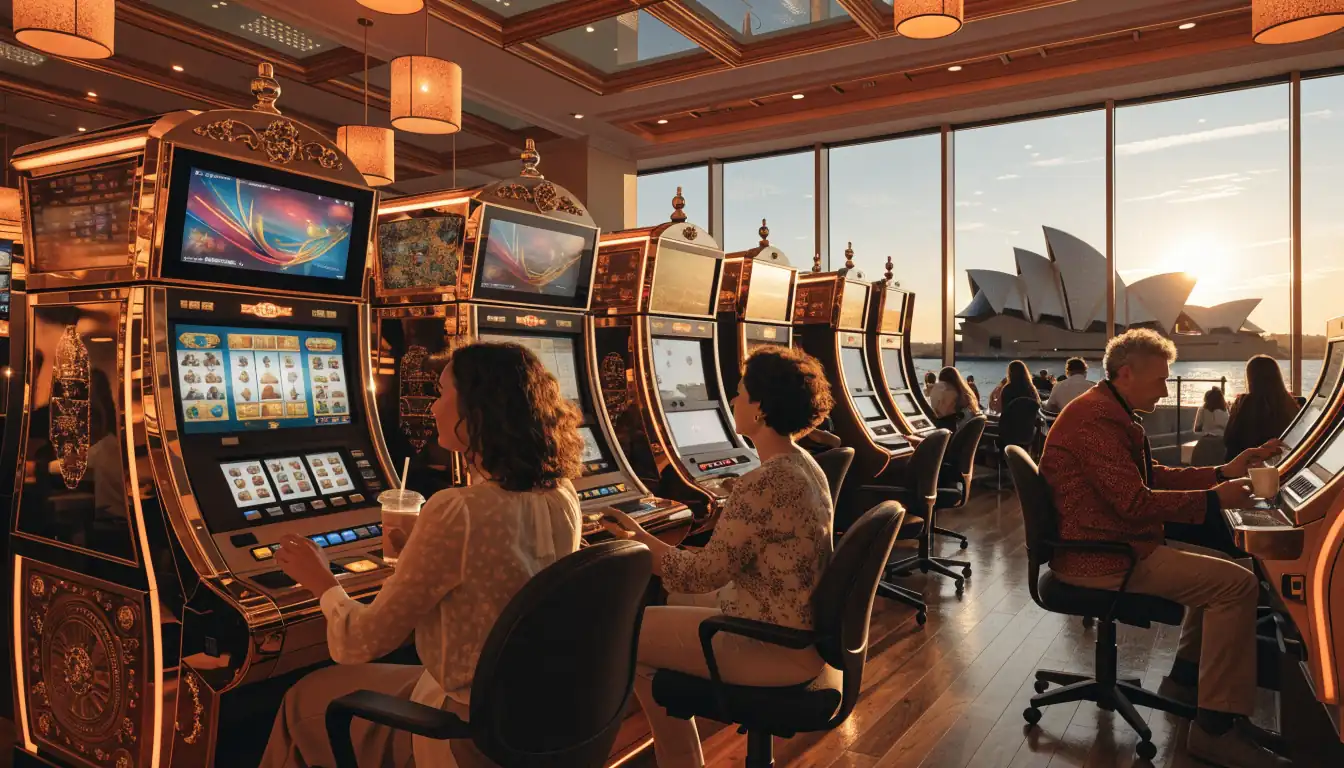
For now, the venue structure that exists today — machines in every jurisdiction, weighted toward clubs and hotels over casinos — is the one the cashless proposals are written against.
Game Variety and Betting Activity on Pokies
A pokie machine in an Australian pub or club is not a single game locked into a cabinet. Modern units run a library of titles — classic three-reel games, five-reel video pokies, and multi-line formats where the bet is spread across dozens of paylines at once. The machine the player sits at matters less than the menu inside it: the same cabinet can carry themed video titles alongside the older mechanical-style games that give pokies their name.
The variety is largely cosmetic in one respect. Themes, animation and bonus rounds differ from title to title, but the underlying structure — a bet, a spin, a programmed payout schedule — is the same across the range. Which specific titles dominate venue floors is not something regulators publish in a ranked list, and venue operators do not disclose their game line-ups as market data, so any claim about "the most popular pokie machine names" rests on marketing material rather than audited figures.
What is documented is the volume. In the financial year 2020-2021, Australians placed bets worth almost AUD 150 billion on electronic gaming machines — a figure that covers play across pubs, clubs and casinos nationally. Complyadvantage.com reports a higher number for a later period: AUD 191.2 billion in pokie gambling turnover in 2023. The two figures come from different sources and different years, so they are not directly comparable, but both describe the same order of magnitude. This is not a niche pastime measured in millions; it is one of the largest channels of consumer spending in the country.
That scale is the product of variety, not despite it. A venue stocked with a single game would exhaust its audience; a floor of rotating titles, themes and bet configurations keeps the turnover cycling. The bet range on individual machines is set by the operator within state regulations, and no verified national figures exist for average bet sizes — the audited numbers describe aggregate turnover, not the behaviour of the individual player at the cabinet.
For anyone comparing pokie machine games, the practical takeaway is this: the choice of title changes the experience, not the economics. The house edge is a property of the machine’s configuration, and the turnover figures above show where that edge accumulates over a national player base across a full financial year.
Playing Pokies for Real Money: Taxation and Legal Considerations
Real-money play on pokies in Australia exists in a specific legal and fiscal framework. The rules differ depending on which side of the machine you stand: the player or the operator.
The legal side for players
Physical pokie machines operate legally in pubs, clubs and casinos across all Australian states and territories, and playing them for real money is lawful for anyone aged 18 or over. Winnings are simply money the player keeps — Australia does not tax gamblers’ winnings. There is no declaration, no income tax line, no capital gains event on a jackpot. A win of any size belongs to the player in full, because gambling is treated as recreation rather than a profession. Someone who does not declare a pokie win is not avoiding tax; there is no tax on it to declare.
Where the law draws the line: online
The Interactive Gambling Act 2001 (IGA) is the piece that matters for anything screen-based. It makes it an offence for online operators to offer real-money gambling to Australian residents — casino-style games including pokies fall squarely inside that prohibition. The offence sits with the operator, not the player: an individual Australian who plays at an offshore site is not committing a crime, but no domestic licence for an online casino exists, so there is no locally regulated online pokie option at all. Any site presenting itself as a licensed Australian online casino is describing a licence that does not exist in this market.
This is also why "real pokie machine apps" for cash play occupy an awkward position: the machines in the app store with familiar gameplay are demo or social versions, not a route to real-money play under Australian law.
Buying a machine
A genuine search behind "buy pokie machine" runs into a separate set of rules. Owning a gaming machine is regulated at state level, and a machine approved for venue operation is not simply retail merchandise. The purchase itself is the easy part; the licensing, registration and compliance obligations attached to operating one are where the real cost sits.
The operator’s side: a different calculation
Operators do not enjoy the player’s exemption. Taxation of gambling operators in Australia varies by state and by type of gambling service — the rate applied to pokies revenue in one jurisdiction differs from another, and different gambling products attract different treatment. For venues, pokies are a taxed business; for the person at the machine, they are untaxed entertainment. The asymmetry is deliberate and worth knowing before either party plans around it.
Pokie Apps, APIs and Integration: Technology Behind the Slots
The software layer around pokies is where machine management, player accounts and compliance reporting now meet. A venue running electronic gaming machines (EGMs) no longer deals only with cabinets and coins; it deals with systems that track play, link machines to a central monitor, and feed data to regulators.
Apps for machine management
A pokie machine app in the venue context is not a game on a phone — real-money online pokies cannot be offered to Australian residents under the Interactive Gambling Act 2001. What the term covers in practice is operational software: applications that let venue staff view machine status, monitor turnover, and manage player accounts where an account-based system is installed. Free demo versions of pokie games exist as separate products and sit outside this compliance picture entirely.
APIs and integration
Integration tools connect the pokie floor to the venue’s broader systems — accounting, loyalty programs, and regulatory reporting. The compliance obligations attached to those integrations are set by AUSTRAC, Australia’s financial intelligence agency.
AUSTRAC issued a guide in 2024 to help firms recognize money-laundering red flags. The indicators it lists include unusually high cash access, large deposits, cash transfers, casino disbursement checks, and certain occupations. A well-integrated system surfaces those indicators automatically; a poorly integrated one leaves the venue to spot them manually.
Compliance obligations by machine count
The thresholds are mechanical:
- Up to 15 pokies. Operators must register with AUSTRAC, keep identification records, and submit suspicious matter reports.
- More than 15 pokies. The obligations extend further — a compliance officer, risk assessments, an AML/CFT program, customer due diligence, and reporting of cash transactions over AUD 10,000.
Why integration matters
The software stack is not an optional convenience here. Cash flowing through pokies with limited traceability is a recognized money-laundering channel, so the systems that record who played, how much went in, and how much came out are the same systems that satisfy AUSTRAC’s reporting requirements. A venue choosing integration tools is, in effect, choosing how defensible its compliance file will be — the technology and the regulation were designed as one package.
Understanding RTP and Practical Tips for Pokie Players
Return to Player (RTP) is the share of money wagered on a pokie machine that is paid back to players over time. The remainder is the venue’s and operator’s margin. RTP is a long-run average: it describes millions of spins, not any single session, so a short run of play can finish far above or below the stated figure.
Cashless, account-based machines change what a player can verify with their own records. Transparent account-based pokies provide full traceability of deposits, gameplay and withdrawals, and according to facctum.com, their adoption improves traceability and reduces anonymity. A session summary on such a system lets a player compare money in against money out — the practical test of what a machine actually returned.
Tips that survive arithmetic:
- Set a fixed amount before playing and treat any loss of it as a cost, not a loan to be recovered.
- Judge results by totals over time, never by a single win.
- Use the traceable records of account-based play where available.
- Treat RTP as a description of the machine’s economics, not a forecast of an individual outcome.
Created by the ”Casino Payment Info” editorial team.