Best Pokies in Canberra: Where to Play in 2026
 Available in AU
Top Pokies to Play in Canberra in 2026
Canberra occupies an unusual position in the Australian pokie landscape. It is a small market by machine count, one of the most tightly regulated jurisdictions in the country, and — as of the mid-2020s — a market in transition, with the casino finally operating machines of its own and the ACT government pushing venue operations toward cashless systems. For a player walking into a venue in 2026, this changes the practical calculus: where to play, which machines are worth feeding, and how the new payment infrastructure affects session budgets.
This section covers the physical side of the equation — the casino, the club network, opening hours, cashless play, and the specific titles and mechanics that justify a seat in front of a machine. Online options are a separate matter, and a separate section of this page.
How the Canberra Pokie Market Is Structured
The ACT licenses electronic gaming machines differently from the states. There is no large suburban pub network of the kind found in New South Wales or Victoria. Instead, the market is built around two pillars:
- The licensed clubs. Canberra’s club sector — the Labor Club group, the Southern Cross Club, the Vikings group, the Raiders clubs, and a handful of smaller community clubs — holds the bulk of the territory’s machine licences. These are the venues most Canberrans mean when they talk about “the pokies”: members’ clubs with bistro dining, sports broadcasts, and gaming rooms tucked behind the front bar.
- Casino Canberra. For most of its history, the casino in the city centre was the oddity of Australian gambling — a casino with no pokies, because ACT law reserved machines for clubs. That changed when the territory legislature approved casino gaming machines, and by 2026 the casino operates its own gaming floor alongside its table games.
Since online pokies fill the gap left by Canberra’s limited local gaming floors, it pays to check how each site is licensed and what its welcome offer actually involves before you sign up.
License: Curacao Gaming Control Board (TechSolutions Group N.V.) · Bonus: 100% up to A$250 + 100 free spins (1st deposit) Licensed under the Curacao Gaming Control Board through TechSolutions Group N.V., this site pairs its first deposit with a 100% match up to A$250 plus 100 free spins.
License: Curacao eGaming OGL/2024/923/0383 (Antillephone N.V.) · Bonus: up to A$2,000 + 100 free spins across 2 deposits · Min. deposit: A$30 Regulated under a Curacao eGaming licence held by Antillephone N.V., it offers a welcome package worth up to A$2,000 plus 100 free spins spread across two deposits, with a A$30 minimum deposit.
License: Curacao eGaming (Roby Games Ltd) · Bonus: 100% up to A$750 + 200 free spins Operating under a Curacao eGaming licence via Roby Games Ltd, it welcomes new players with a 100% bonus up to A$750 plus 200 free spins.
License: Curacao eGaming OGL/2023/174/0082 (Dama N.V.) · Bonus: up to A$10,000 + 500 free spins across 4 deposits · Min. deposit: A$15 Licensed under Curacao eGaming through Dama N.V., it stands out for a large welcome package of up to A$10,000 plus 500 free spins across four deposits, with just a A$15 minimum deposit.
License: Curacao Gaming Control Board · Bonus: up to A$5,000 + 400 free spins Holding a Curacao Gaming Control Board licence, it offers a sizeable bonus of up to A$5,000 plus 400 free spins for new players.
License: Curacao (operating since 2017) · Bonus: 250% up to A$2,000 + 50 free spins on the first of six deposits · Min. deposit: A$20 Licensed in Curacao and running since 2017, it offers a distinctive 250% match up to A$2,000 plus 50 free spins on the first of six qualifying deposits, with a A$20 minimum deposit.
License: Curacao Gaming Control Board OGL/2023/174/0082 (Dama N.V.) · Bonus: up to A$5,000 + 300 free spins across 4 deposits Licensed by the Curacao Gaming Control Board via Dama N.V., it provides a bonus of up to A$5,000 plus 300 free spins spread over four deposits.
License: Curacao Gaming Control Board OGL/2023/176/0095 (Hollycorn N.V.) · Bonus: 100% up to A$10,000 + 100 free spins Operating under a Curacao Gaming Control Board licence through Hollycorn N.V., it offers a generous 100% bonus up to A$10,000 plus 100 free spins.
Bonus: 100% up to A$750 + 200 free spins, 35x wagering · Payout speed: crypto 30-120 minutes, fiat 24-72 hours · Min. deposit: A$30 This site offers a 100% bonus up to A$750 plus 200 free spins with 35x wagering, and it stands out for fast payouts, with crypto withdrawals processed in as little as 30 to 120 minutes and fiat within 24 to 72 hours; minimum deposit is A$30.
Bonus: up to A$7,500 + 550 free spins across 10 deposits, 50x wagering · Payout speed: crypto under 1 hour, PayID 1-3 business days · Min. deposit: A$20 (A$30 to qualify for the bonus) It offers an extensive bonus of up to A$7,500 plus 550 free spins across ten deposits with 50x wagering, and payouts are notably quick via crypto in under an hour or PayID within one to three business days; minimum deposit is A$20, though A$30 is needed to qualify for the bonus.
The practical consequence for a player: Canberra offers fewer venues than Sydney or Melbourne, but each club gaming room is larger, better maintained, and more actively managed than the average suburban pub machine bank. The territory’s regulator, the ACT Gambling and Racing Commission, also imposes stricter harm-minimisation settings than most jurisdictions — mandatory pre-commitment options, loss limits tied to the territory’s player card system, and a regulator that publishes venue-level data.
That last point matters to anyone comparing venues. The Commission publishes expenditure and loss data by venue. A player deciding between two clubs does not have to rely on signage or word of mouth; the regulator’s own reporting shows where the money actually goes, and the pattern is stable enough year to year to be a real decision input rather than trivia.
Casino Canberra: The New entrant
Casino Canberra spent decades as the only capital-city casino in Australia without a single poker machine. The legislative change that allowed the casino to operate machines was contested, delayed, and ultimately delivered a gaming floor that looks and plays differently from the club rooms across town.
What distinguishes the casino floor in 2026:
- A mixed denomination layout. Club gaming rooms in Canberra skew heavily toward low-denomination play. The casino floor carries a broader spread, including higher-denomination cabinets that simply do not appear in the club network.
- Linked jackpot arrangements. The casino participates in wider jackpot networks than individual clubs can access on their own, which affects the shape of the top-end prizes on offer — not the odds of any individual spin, but the size of the ceiling.
- Table games adjacent to the machines. For a player who treats a pokie session as part of a broader night out rather than the entire purpose of the trip, the casino is the only venue in the territory where both sit on the same floor.
The honest assessment of the casino versus the clubs is a budget question, not a glamour question. Casino cabinets are not more generous than club cabinets — return percentages on the floor are set within regulatory bands, not by how polished the carpet is. What the casino sells is variety and atmosphere, priced through the same house edge as everywhere else.
The Club Network: Where Canberra Actually Plays
The clubs carry the territory’s gaming volume, and they are not interchangeable. The groups worth knowing:
- The Labor Club group. Multiple sites across the territory, large gaming rooms, and the most aggressive venue refurbishment program of any group. The Civic and Belconnen sites in particular operate gaming floors sized like small casinos.
- The Southern Cross Club. Three sites with a family-dining orientation; the gaming rooms are smaller and quieter than the Labor Club’s, which some players prefer for exactly that reason.
- The Vikings group. Centred on the Tuggeranong valley, with strong membership density in the southern suburbs. The Erindale and Lanyon sites do heavy weekend trade.
- The Raiders clubs. Tied to the NRL club, with sites at Gungahlin and elsewhere; game-day weekends change the character of the gaming room entirely.
None of these venues charges for entry, all require membership or a signed-in guest arrangement, and all operate under the territory’s mandatory player-card framework for machine play. The practical difference between them, beyond travel time, is machine mix — which titles are on the floor, which denominations are stocked, and how quickly cabinets rotate.
Opening Hours: The 24-Hour Question
Search interest in "24 hour pokies Canberra" runs persistent, and the answer is a flat one: the ACT does not run a 24-hour machine market. Venue hours are set by licence conditions and individual venue policy, and the club gaming rooms close — late on weekends, earlier on weeknights, but they close. This is one of the sharpest practical differences between Canberra and, say, parts of Queensland or the Northern Territory, where genuinely round-the-clock venues exist.
For a player planning a session, the working rules are:
- Weekend nights run latest. Major club gaming rooms in Canberra extend their hours on Friday and Saturday, and the casino operates the longest continuous hours of any licensed venue in the territory. If the plan is a late session, the casino is the anchor option and the clubs fill in around it.
- “Open now” is a checkable fact, not a guess. Every major club group publishes current trading hours on its own site, and hours shift with public holidays, daylight saving, and venue events. Any page that promises a fixed schedule for Canberra venues — including this one — is out of date by design; the venue’s own listing is the only live source.
- Public holidays compress the market. ACT public holidays shorten trading at several clubs while leaving the casino closer to its normal schedule.
The short version: Canberra is not a market for the 3 a.m. session. Anyone whose plan depends on that should re-plan before budgeting anything else.
Cashless Pokies in Canberra
The territory has moved further down the cashless path than most Australian jurisdictions, and by 2026 cashless play is no longer a novelty in Canberra venues — it is the direction the entire floor is heading.
What this means in practice:
- Card-linked play. Machine sessions in the ACT operate through the territory’s player card and pre-commitment infrastructure. Load funds at a kiosk or the cashier, play through the card, cash out the balance at the end. The era of feeding notes directly into a machine for an unbounded session is closing, by policy design.
- Loss limits are set before the session, not after. The pre-commitment system means a player nominates limits when signing up, and the venue’s system enforces them. For anyone who has watched a planned two-hour session double itself, this is the single most consequential change to Canberra machine play in a generation — not because it changes any machine’s return, but because it changes the maximum exposure before the night starts.
- The budget discipline is structural. A cashless floor converts “how much is in the wallet” into a visible, declining balance on a screen. The practical effect is the same as a separate spending account: the session cost is legible while there is still time to act on it.
Cashless play does not alter the mathematics of any machine. What it does is remove the friction points — the note acceptor, the hand-to-pocket reflex, the quiet drift from one withdrawal to the next — that turn a small planned loss into a large unplanned one. In a jurisdiction that publishes venue loss data, that is the frame in which the system was built, and it is the frame in which it works.
The Titles Worth a Seat in 2026
A list of "best pokies" that names no machines is a list of nothing. Below are the titles that, across the cabinets and game menus available to Canberra players in 2026, justify attention — each for a measurable reason, not a theme or a soundtrack. Where a figure is attached, it comes from a named source; where no verified figure exists, the entry says what it is and stops there.
-
Book of 99. A high-return title built around a single expanding-symbol mechanic and a collection meter that counts toward the feature. Its reputation rests on return percentage at the top of the market — a game designed to advertise its own generosity rather than hide it. For players comparing cabinets on paper before committing a bankroll, it is the reference point.
-
Gates of Olympus 1000. Pragmatic Play’s scaled-up take on the tumble-and-multiplier formula: cascading symbols, random multipliers that accumulate through a chain, and a bonus round built on multiplier values rather than line hits. It is a high-volatility design — long stretches of nothing punctuated by concentrated payouts — which suits a small-stakes, patient session and punishes a large-stakes, impatient one.
-
Mega Joker. The classic two-tier cabinet design: a base game and a “supermeter” mode where wins can be pushed upward for higher-tier play. It is one of the older layouts still stocked, and it persists precisely because the supermeter structure gives the player a decision — bank the win or escalate it — that most modern machines never offer. A rare case of a machine treating the player as a participant in the maths.
-
Mega Moolah. The progressive jackpot title with the longest track record in the category. A portion of every wager feeds the linked jackpot pool, which is why the headline return on the base game sits below the titles above and why the top-end prize climbs without a ceiling. The calculation is straightforward: the jackpot is funded by the players chasing it. Mega Moolah is a lottery ticket with a pokie attached, and it should be budgeted as one.
-
Merge Up. BGaming’s cluster-based design where matching symbols merge into upgraded versions, creating a compounding effect through a single spin chain. The mechanic rewards chains in a way line-based games cannot, and it represents the newer generation of titles appearing on cabinets and game menus aimed at Australian venues.
-
Need for Spin. A racing-themed title built on respin and collection mechanics — the design school where near-misses and partial collections carry the session between features. The theme is the packaging; the substance is the respin frequency, which is what separates this family of games from the older three-reel stock.
-
Snoop Dogg Dollars. BGaming’s celebrity-branded release, and evidence of where the supply side is going: licensed properties aimed at players who arrive through the brand rather than the mechanic. The underlying gameplay is a modern feature-heavy layout — worth a look for the novelty, budgeted like any other high-variance title.
-
Starburst. The old standard. Expanding wilds, both-way pays, no free-spin round to wait for. It endures on floors and game menus because it pays steadily in small increments — the opposite profile to Gates of Olympus 1000 — and it remains the sensible calibration point for what a low-volatility session feels like.
Eight titles, three volatility profiles, one jackpot structure. The selection logic is the same as any purchase decision: match the machine’s payout shape to the session budget, not to the cabinet artwork.
Mechanics That Decide the Outcome
Knowing the titles is the entry-level knowledge. The mechanics below are what actually separate a planned session from a donation.
Return percentage versus hit frequency. A machine’s return to player is the theoretical share of wagered money it pays back over time — the long run, not the evening. But return percentage alone is a poor buying criterion. A pokie running a 97% return with an 8% hit frequency produces long dry spells: the money comes back, but it comes back in concentrated bursts separated by stretches where nothing lands. A lower headline return with a higher hit frequency produces the opposite experience — a flatter, more survivable session on the same budget. The trap is selecting a machine on the return figure alone and discovering that the figure describes a version of the game that only exists across tens of thousands of spins. The evening version is governed by hit frequency, and the evening is the version that gets played.
Relying solely on a machine’s RTP can be misleading; a high RTP does not guarantee frequent wins, and low hit frequency may still produce a pleasant session despite the theoretical return.
The bonus buy mechanic. Where a title offers a direct purchase of its feature round, the purchase is not neutral. According to moviemaker.com’s 2026 coverage, the Feature Buy mechanic can raise a game’s effective return by 0.5% to 1.5% — the bought bonus runs on better mathematics than the one ground out through base play. The catch is arithmetic: the improvement is fractional, while the buy-in cost is a large multiple of the base spin. A slightly better percentage applied to a much larger stake is still a much larger exposure. The mechanic rewards players who were buying the feature anyway and does nothing for anyone else.
Progressive jackpots. Linked machines pool a slice of every wager into a prize that grows until it is won. The trade is transparent: a portion of the return is diverted from regular play into a prize with a vanishingly small individual probability. According to one industry review of Australian-facing venues, progressive jackpots remain a headline feature of the category. The budget logic is unambiguous — a progressive machine is a worse expected-value proposition per spin for anyone who does not win the jackpot, and the jackpot is not a plan.
Progressive jackpot titles typically offer a lower expected return on each spin because a portion of every wager is diverted to the jackpot pool, which benefits only the rare winner.
Wager-free promotions. Where a venue or platform attaches free spins without wagering requirements, the winnings are withdrawable immediately rather than cycled back through play. Per moviemaker.com, wager-free spins are a 2026 trend. For the physical-venue player this appears mostly through club promotions and player-card offers; the practical value is that the promotion’s return arrives as money rather than as an obligation to keep playing.
Hybrid Play: The Cabinet and the Browser
The line between the venue floor and the game menu has thinned. The same titles — the Pragmatic Play, BGaming, Hacksaw Gaming, and ELK Studios catalogues among them — appear on Canberra-friendly platforms in browser-based form. Per moviemaker.com’s 2026 reporting, progressive web apps (PWAs) now allow full casino access without any app download: the site installs to a phone’s home screen and runs as an application, with no storefront approval process in between.
For the Canberra player, this hybrid reality cuts two ways. On one side, the titles and mechanics described above do not require a venue visit — the game menu is reachable from anywhere. On the other side, the venue floor carries what the online catalogue cannot: the regulatory framework of the ACT system, the pre-commitment infrastructure, and the loss data the Commission publishes. A player who wants the Merge Up mechanic can find it in both worlds; a player who wants enforced loss limits before the session starts will only find them in one of them.

The legal frame is worth stating plainly, because it shapes the whole hybrid picture. Under the Interactive Gambling Act 2001, online casino games — pokies among them — cannot be offered to Australian residents, and no domestic licence for that product exists. Playing at an offshore-licensed site is not an offence for the individual; the law targets operators. What this means practically: the domestic, regulated, fully protected version of pokie play in Canberra is the venue floor, and everything else sits outside the territory’s player protections. That is not a moral observation. It is a line in the risk calculation.
What the Numbers Do and Do Not Say
Moviemaker.com’s 2026 guidance sets a working floor: players should not settle for a pokie with a return below 96%. As a screening rule it is serviceable — it eliminates the bottom of the market before any money is committed. As a promise it is worthless. A 96% return is a 4% cost of play, incurred on every wager, recovered only in the theoretical long run. At any realistic session length, the variance around that figure dwarfs the figure itself.
Using a 96 % RTP threshold as a hard rule can give a false sense of security; session variance will still dominate short‑term results, so players should manage bankroll regardless of the filter.
The disciplined approach treats the published return as a filter, the hit frequency as the experience predictor, and the session budget as the only number the player actually controls. The ACT’s card system makes the third of those enforceable. The first two require reading the machine’s information screen before the first spin — a step that costs nothing and is skipped almost universally.
Choosing a Venue: The Working Checklist
Condensing everything above into the decision a player actually makes on a given night:
- Decide the session budget before choosing the venue. The venue choice should fit the budget, not the reverse.
- Check the venue’s own published hours, same day. Canberra does not run a 24-hour machine market; weekend extensions and holiday reductions move the closing time week to week.
- Match the machine profile to the budget. High-variance titles (Gates of Olympus 1000, the progressive jackpots) for small stakes and patience; high hit-frequency layouts (Starburst, the respin family) for flatter, longer sessions.
- Use the pre-commitment limits as they are designed. The ACT system exists to convert good intentions into enforced stops. A limit set at sign-up is the cheapest insurance available in the building.
- Read the machine’s information screen. Return percentage, hit behaviour, and feature costs are on the cabinet before the first credit goes in.
- Treat promotional offers as arithmetic. A wager-free spin has a calculable value; a wager-attached offer is a commitment to future play dressed as a gift.
- Confirm age and membership requirements before travelling. The minimum legal gambling age in Australia is 18, every Canberra venue checks it, and clubs additionally require membership or guest sign-in at the door.
The State of the Market
Canberra in 2026 is a small market being remade on two fronts at once: the casino’s arrival as a machine venue, and the territory’s cashless and pre-commitment infrastructure reshaping how every session runs. Neither development changes the mathematics of a single spin. What changes is everything around the spin — the information available before play, the limits enforced during it, and the visibility of the result afterward.
For a player who treats a pokie session as a purchase of entertainment with a known maximum cost, the Canberra of 2026 is a better-organised market than the one that preceded it. For a player looking for a machine that will pay, no reorganisation of the market changes the answer to that question: the machine’s design already contains the answer, it is published on the cabinet, and it was never the part of the evening worth optimising.
Online Casino Pokies Options for Canberra Players
The legal position comes first, because it shapes every option that follows. Under the Interactive Gambling Act 2001, online casino games — pokies included — cannot be lawfully offered to Australian residents, and no domestic licence for that type of gambling exists. What is not prohibited is playing: the law targets operators, not individuals. A Canberra resident who opens an account at an offshore-licensed site is not committing an offence. That asymmetry is why this section talks about offshore operators, and why phrases like "choose a licensed local casino" have no meaning here — there is no local licence to check.
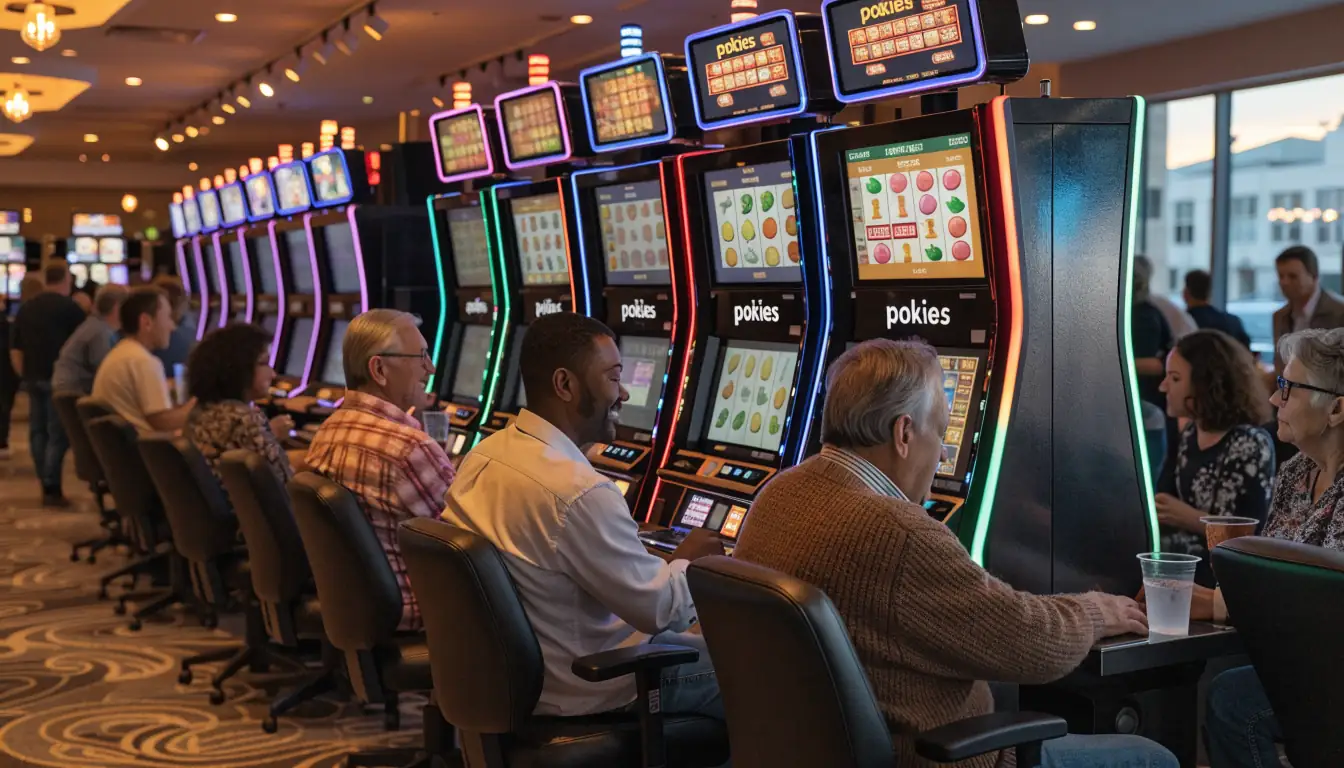

What offshore sites offer Canberra players
There is no domestic product to compare, so the comparison happens between offshore operators. According to one industry review of Australian-facing casinos, several features now recur across the better sites:
- No-wagering pokies bonuses. Winnings from these bonuses are not locked behind a turnover condition. One and the same review reports that some Australian-facing casinos structure offers this way, and that wager-free spins have become a distinguishable trend — winnings from them can be withdrawn immediately. Wagering requirements, where they do apply, must be stated up front before a bonus is offered; an operator that hides that figure is answering the question before it is asked.
- No deposit free spins. Some Australian-facing casinos grant free spins without requiring a prior deposit. The value of such an offer lies entirely in whether the spins carry a wagering condition — free spins with a turnover requirement and free spins without one are different products wearing the same name.
- Weekly free-spin promotions. Recurring promotions are reported at some operators. These reward continued play rather than the first deposit, which shifts the arithmetic: the first-deposit bonus is a one-off line item, the weekly promotion is a recurring one.
- Instant cashouts. According to the same review, some Australian-facing casinos process withdrawals instantly rather than in queued batches. Verification comes before any payout — a government-issued ID check before withdrawal is a compliance requirement, not an optional convenience, so the fastest realistic path runs through an account verified in advance.
No deposit bonus, real-money play, and withdrawal speed are three separate questions. A site can score well on one and poorly on the others; the terms attached to each, not the headline, decide the order.
How money moves
The New Payments Platform has considerably changed how Australians move money, and that reaches offshore gambling accounts through the same rails. Within the NPP, PayID links an Australian bank account to a mobile number or email address, and Osko transactions settle in real time around the clock. For a Canberra player, this means a deposit can leave a local account and land in a gambling wallet without a card or a pending-period bank transfer. One constraint is fixed regardless of platform: credit cards cannot lawfully be used for gambling payments in Australia, and the deposit options at compliant operators reflect that.
Crypto is the alternative path. Its withdrawal terms vary more than PayID’s, and the verification obligations attached to crypto transfers have tightened — but the specific payout speeds belong to the next paragraph, not to a general claim.
Self-exclusion
Offshore status does not remove the tools, only the domestic regulator. According to one industry review, the better platforms in this space include deposit limits, reality checks, and self-exclusion tools. Canberra players who want a hard stop can use a site’s own self-exclusion feature, and Gambling Help Online operates nationally regardless of where an operator is licensed. The practical difference is that no ACT authority can enforce an offshore site’s commitment — which makes the tools present on the site, not the licence, the thing worth reading before depositing.
Understanding Pokie Payout Percentages in Canberra
The payout percentage, or RTP (return to player), is the theoretical share of wagered money a pokie returns to players over time. It is a long-run figure, not a promise about any single session — a short run of spins can land well above or below it without the machine deviating from its programmed rate.
For Canberra players comparing games in 2026, one industry review (moviemaker.com) sets a clear floor: don’t settle for a pokie with RTP below 96%. Titles such as Book of 99 sit above that line, which is why RTP is the first number worth checking before committing money to a machine.
One caveat: a high RTP says nothing about how often a game pays. Hit frequency matters too, since a game can return generously over time while still producing long stretches without a win.
How can a player verify that an online casino holds a valid licence in Australia?
Check the casino’s website for licensing details — reputable platforms display their regulator information in the footer. If a casino mentions Anjouan Gaming, note that its regulatory scope is limited and does not carry the same weight as a national-level licence.
Can I play on an Australian online casino on mobile?
Yes. In 2026, many top platforms use Progressive Web Apps (PWAs), which enable full casino access directly through a mobile browser without requiring an app download.
How can I manage deposits and withdrawals responsibly?
Use platforms that provide deposit limits, reality checks, and self-exclusion tools. For deposits, the New Payments Platform and PayID allow real-time bank transfers, while responsible casinos process crypto withdrawals efficiently — some handling over 90% of crypto payments in under 15 minutes.
What is the regulatory scope of Anjouan Gaming?
Anjouan Gaming provides a licence with limited regulatory scope compared to national regulators. Australian players should verify whether a casino displaying this licence also holds stronger credentials or operates under a more robust jurisdiction.
Are my personal and financial details safe?
Top platforms protect your data through verified payment systems. Australian banks rolled out the Confirmation of Payee service in July 2025, and crypto transfers are subject to the Travel Rule, which requires casinos to attach verified ID details to transactions.
How does a progressive jackpot pokie work?
Progressive jackpots pool prize contributions across a network of machines or games, building a top-end prize that grows until it is won. Casinos like Goldenbet offer progressive and network jackpots where the prize ceiling increases with wider participation.
What does RTP mean in pokies?
RTP is the theoretical percentage of wagered money a pokie returns to players over time. In 2026, players should avoid pokies with RTP below 96%, and titles at venues like Wild Tokyo typically offer RTP around 96% or higher.
Prepared by the Casino Payment Info editorial staff.