
Best Casinos for Online Craps in Australia
Understanding Craps: Game Basics and Popularity in Australia
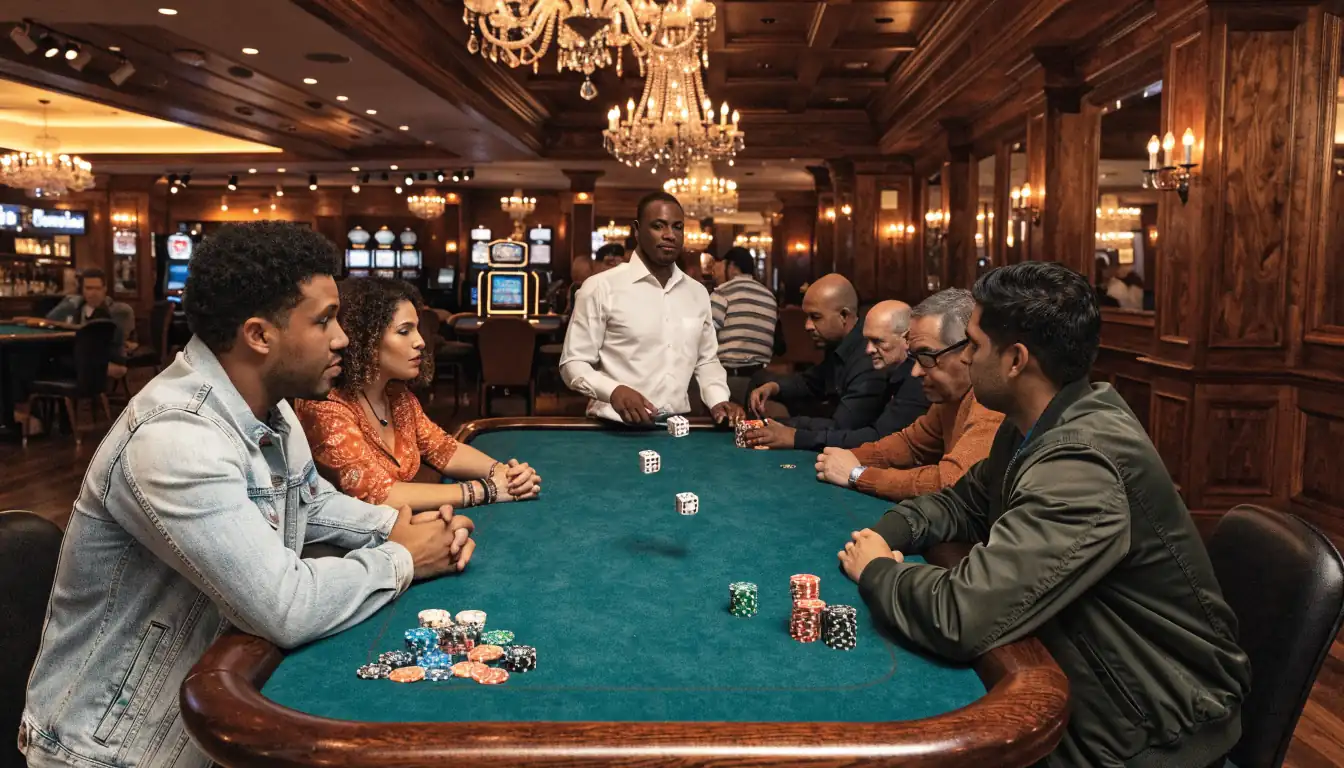
Craps occupies a strange position in Australian gambling culture. It is one of the oldest dice games still played in casinos, it carries a reputation built almost entirely on its table atmosphere, and yet it remains a niche pursuit compared to blackjack, roulette and the pokies that dominate the local floor. For a game that many Australians have never actually played, craps has a disproportionate cultural footprint — film scenes, Las Vegas lore, and a vocabulary of slang that has outlived the smoky rooms it came from. This section sets out what the game actually is, how a craps table works, why the game holds the place it does among Australian gamblers, and the regulatory structure that sits behind every casino craps table in the country. Later sections deal with the online side of the question — the variants, the live-dealer products and the specific legality of real-money play over the internet — so those subjects stay out of scope here.
What craps is
Craps is a dice game built around the roll of two six-sided dice. One player — the shooter — throws the dice, and every other player at the table bets on the outcome of that throw or a sequence of throws. The total of the two dice determines who wins. That is the entire mechanical premise: two dice, a total, a wager.
Since online craps depends on fast, reliable payouts and a welcome offer worth grinding through, it’s worth checking how each casino’s licensing and bonus terms stack up before you place your first bet.
License: Curacao Gaming Control Board (TechSolutions Group N.V.) · Bonus: 100% up to A$250 + 100 free spins (1st deposit) Licensed under the Curacao Gaming Control Board via TechSolutions Group N.V., this casino welcomes new players with a matched deposit bonus plus free spins on the first deposit.
License: Curacao eGaming OGL/2024/923/0383 (Antillephone N.V.) · Bonus: up to A$2,000 + 100 free spins across 2 deposits · Min. deposit: A$30 Operating under a Curacao eGaming licence held by Antillephone N.V., it offers a sizeable welcome package spread across two deposits with a low minimum deposit requirement, making it easy to get started.
License: Curacao eGaming (Roby Games Ltd) · Bonus: 100% up to A$750 + 200 free spins Licensed through Curacao eGaming under Roby Games Ltd, this casino pairs a solid matched bonus with a generous batch of free spins for new players.
License: Curacao eGaming OGL/2023/174/0082 (Dama N.V.) · Bonus: up to A$10,000 + 500 free spins across 4 deposits · Min. deposit: A$15 Backed by a Curacao eGaming licence from Dama N.V., this operator stands out for a large welcome package spread across four deposits and a notably low minimum deposit.
License: Curacao Gaming Control Board · Bonus: up to A$5,000 + 400 free spins Holding a Curacao Gaming Control Board licence, this casino offers a substantial welcome bonus combined with a large number of free spins.
License: Curacao (operating since 2017) · Bonus: 250% up to A$2,000 + 50 free spins on the first of six deposits · Min. deposit: A$20 A long-running Curacao-licensed casino operating since 2017, offering a high-percentage bonus spread over the first of six deposits along with a low minimum deposit to qualify.
License: Curacao Gaming Control Board OGL/2023/174/0082 (Dama N.V.) · Bonus: up to A$5,000 + 300 free spins across 4 deposits Licensed under the Curacao Gaming Control Board via Dama N.V., this site offers a substantial welcome bonus split across four deposits alongside a decent free spins allotment.
License: Curacao Gaming Control Board OGL/2023/176/0095 (Hollycorn N.V.) · Bonus: 100% up to A$10,000 + 100 free spins Licensed by the Curacao Gaming Control Board through Hollycorn N.V., this casino offers one of the larger matched welcome bonuses on the list along with free spins.
Bonus: 100% up to A$750 + 200 free spins, 35x wagering · Payout speed: crypto 30-120 minutes, fiat 24-72 hours · Min. deposit: A$30 This casino combines a matched welcome bonus and free spins with fast crypto payouts, typically clearing within a couple of hours, while fiat withdrawals take a bit longer; a low minimum deposit keeps entry accessible.
Bonus: up to A$7,500 + 550 free spins across 10 deposits, 50x wagering · Payout speed: crypto under 1 hour, PayID 1-3 business days · Min. deposit: A$20 (A$30 to qualify for the bonus) Offering one of the larger multi-deposit welcome packages on this list, it also delivers quick crypto payouts and reasonably fast PayID withdrawals, though a higher deposit is needed to unlock the full bonus.
What separates craps from most other casino games is the structure around that premise. The table is large, the betting layout is dense with marked positions, and the players themselves are not betting against each other — they are, in the most common forms of the game, betting with the shooter against the house. When the shooter wins, most of the table wins. When the shooter loses, most of the table loses together. This shared outcome is the root of everything people say about craps atmosphere. It is the only mainstream casino game where a whole crowd of strangers has a common financial interest in a single pair of dice.
The game descends from an old European dice game called hazard, which circulated through English gambling houses for centuries before crossing to America, where the French-speaking communities of Louisiana simplified the rules and gave the game its modern name. The version played in casinos today — the double-ended table, the marked layout, the come-out roll — was standardised in American casinos in the twentieth century and exported from there to the rest of the world, including Australia.
The basic mechanics of a craps table
A casino craps table is built around two phases: the come-out roll and the point roll. Understanding these two phases is enough to follow any game of craps, anywhere it is played.
The come-out roll. The game begins with the shooter throwing the dice. If the total is seven or eleven, the shooters and everyone betting on the pass line win immediately, and the dice stay with the shooter. If the total is two, three or twelve — the numbers collectively called "craps" — the pass line loses. Any other total — four, five, six, eight, nine or ten — establishes a point. The dealer marks the point on the table, and the game moves to its second phase.

The point roll. The shooter keeps throwing the dice. If the point number comes up again before a seven, the pass line wins and a new come-out roll begins. If a seven comes up first, the pass line loses, the round ends, and the dice pass to the next shooter. The seven is the pivot of the whole game: it is the most likely total when two dice are thrown, which is why it wins on the come-out roll but loses during the point roll. Every other bet on the table is, in one way or another, a variation on this tension between the point and the seven.
The dice themselves. Casino craps is played with precision dice, and the throwing rules are strict. The shooter must throw the dice the length of the table so that they hit the far wall — a requirement designed to prevent controlled or "set" throws. Dice that leave the table, or land crooked against a stack of chips, are called "no roll" and thrown again. A roll only counts when both dice settle flat on the table surface.
The betting layout
The intimidation factor of craps comes almost entirely from the layout. A full craps table carries dozens of marked betting positions, and a new player looking at the felt for the first time sees an apparently impenetrable grid. In practice, the layout breaks into a small number of families.
The shooter must throw the dice the length of the table so that they hit the far wall; any throw that does not fulfil this rule is called a “no roll” and must be re‑thrown.
Pass line. The foundational bet. It wins on a come-out roll of seven or eleven, loses on craps, and during the point roll it wins if the point repeats before a seven. It is paid at even money — one unit won for one unit staked. The pass line is the bet that the crowd is on, and it is the one to learn first.
Don’t pass. The mirror image. The don’t pass bettor wins when the pass line loses — with one carve-out on the come-out roll, where a roll of twelve is a push rather than a win for the don’t side. Betting don’t pass is betting against the shooter, which is mathematically respectable and socially lonely: the don’t bettor collects when the rest of the table groans. This is where craps earns its reputation for table culture — it is the only game where the crowd’s opponent is visibly sitting among them.
Come and don’t come. These are pass-line-style bets that can be placed after the point is established. A come bet works like a fresh pass line built on the next roll: it wins on seven or eleven, loses on craps, and otherwise establishes its own point that must repeat before a seven. The don’t come bet mirrors it.
Odds bets. Once a point is established, a pass line bettor may place an additional bet behind the original wager — the "odds" or "free odds" bet. This is the bet that draws serious craps players to the game, because it is paid at the true mathematical odds of the point repeating rather than at a house-adjusted rate. It is the closest thing to a fair wager that a commercial casino offers anywhere on its floor, which is precisely why the rules around how much can be placed on it are tightly controlled. The specific multiples permitted vary from table to table and from casino to casino, and Australian casinos do not publish a standard figure — the allowed amount is set by the house at each venue.

Place bets, field, proposition bets. Beyond these lie the remaining layout positions. Place bets are wagers on a specific number being rolled before a seven. The field is a one-roll bet on a listed set of totals. The proposition bets — in the centre of the layout, called out to the stickman rather than placed by hand — are one-roll wagers on exact combinations: a specific hardway, a specific total on the next throw. These are the highest-paying and worst-value bets on the table, and experienced players treat them as the price of entertainment rather than a strategy.
Table etiquette. Craps is the only mainstream table game with a substantial body of unwritten rules. Players keep their hands off the table when the dice are in the air, because a hand in the landing zone voids the roll and the goodwill of fourteen other bettors. Chips are bought in through the dealers, never handed over directly. Bets on the layout are placed by the player or positioned by the dealer on call — but never, under any circumstances, handed to the stickman mid-roll. The superstitions are layered and enforced socially: no saying the word "seven" during a point roll, dice changed on a cold table, a new shooter "proving" the dice before betting. None of this is regulation. All of it is real.
Why craps holds its appeal
Strip away the folklore and craps rests on three pillars.
The first is pace. A hot craps table produces resolution after resolution — roll, payout, roll, payout — with no card shuffle, no wheel spin and no dead time between decisions. For a gambler who wants frequent outcomes, nothing on a casino floor matches it.
The second is the odds structure. The combination of a low-edge foundational bet with a true-odds add-on gives craps a mathematical profile that table-game players take seriously. A disciplined player who restricts themselves to the pass line and takes the odds behind it is playing one of the least expensive games in the building per dollar of action. The same table, played through the centre propositions, is one of the most expensive. The game rewards restraint and punishes everything else, and this is visible to anyone who watches a table for an hour.
The third — and the one that resists any spreadsheet — is the social structure. Because most of the table wins or loses together, craps generates collective emotion that no other game produces. A long point roll gathers a crowd, and the shooter becomes, briefly, the most important person in the room. Blackjack is a private conversation between player and dealer. Roulette is a room of individuals watching the same wheel. Craps is a team sport against the house, and that is a product no other table layout sells.
Craps and the Australian gambler
The Australian relationship with craps is shaped by the local market’s composition. Gambling in Australia is legal and long-established — it is one of the most gambling-accepting cultures in the English-speaking world — but the domestic floor has always been weighted heavily toward poker machines and race betting. The pokie is the default gambling product of the country; the race bet is its historical backbone. Table games, and specialty table games like craps in particular, sit in a much smaller tier.

Crown Melbourne, the Southern Hemisphere’s largest casino, is the reference point for serious table-game play in the country. A venue of that scale maintains the full spread of traditional table products, craps among them, and it is at venues of that tier that most Australians first encounter a live craps table rather than a depiction of one. Outside the major integrated resorts, craps tables are thinner on the ground — a function of the game’s economics. A craps table requires a crew of dealers and a large floor footprint, and in a market where the pokie floor does the heavy revenue lifting, the dice table is a premium offering rather than a staple.
What sustains Australian interest in craps is partly the same cultural export that sustains it everywhere: American gambling media, where the craps table is the set piece of choice. Partly it is the traveller — Australians are heavy international travellers, and the craps tables of Las Vegas and Macau and the cruise ships collect Australian players who bring the habit home. And partly it is the player who has worked through the local table staples and is looking for the game with the best odds structure and the steepest learning curve on offer.
The learning curve itself is part of the appeal for a certain kind of player. Craps demands that a newcomer absorb a phase-based game, a dense layout and a body of table law before feeling comfortable. That barrier filters the table down to players who chose to be there, which in turn shapes the table’s culture — a craps table is demanding, fast, and densely social in a way that the blackjack pit, with its silences, is not.
The regulatory backdrop in Australia
The legal environment behind Australian gambling is unusual in one structural respect: there is no single overarching statute and no single overarching gambling authority for the country. Regulation occurs at two levels simultaneously — the Commonwealth (federal) level and the level of the states and territories — and the division of labour between them determines who regulates what.
Illegal Online Play
Under the Interactive Gambling Act 2001, offering real‑money casino games – including craps – to Australian residents is prohibited. Playing on offshore sites offers no local regulatory protection.
The federal layer. At the Commonwealth level, the Australian Communications and Media Authority (ACMA) is the regulator that enforces the Interactive Gambling Act 2001. The IGA governs the online sphere — specifically, what gambling services may be provided over the internet to Australians — and its enforcement sits with ACMA rather than with any state body. The Act was introduced with a public-protection and harm-minimisation purpose, and its scope covers the online provision of casino-style games to Australian residents. This is the layer that matters for anyone thinking about online craps, and it is treated in detail in a later section of this article; the point here is the structure, not the outcome.
The state and territory layer. Land-based gambling — the casino floor, the race track, the pokie venue — is regulated by each state and territory separately. Every Australian jurisdiction has its own gambling regulator, and land-based casinos in Australia answer to those state regulators and to state law enforcement agencies, entirely separately from ACMA’s federal oversight of online gambling. A craps table at a Melbourne or Sydney casino is not an ACMA matter. It is a matter for the state authority that licenses the venue.
The state regulators do more than license floors. The Victorian Gambling and Casino Control Commission (VGCCC), for example, monitors all wagering service providers — including those based in other states — for compliance with the National Consumer Protection Framework, the national rulebook for consumer-facing wagering conduct. State regulators in the largest jurisdictions carry both a local licensing role and a role in monitoring conduct that crosses state borders.
The online wagering layer. Alongside this sits the Northern Territory Racing Commission (NTRC), which functions as Australia’s de-facto online gambling regulator in one specific respect: it licenses most of the national online bookmakers, who base themselves in the Northern Territory for the lower tax treatment. This has produced the odd situation where the country’s online wagering industry is concentrated under a territory regulator rather than spread across the states where its customers actually live.
Put together, the structure is this: the physical craps table in an Australian casino is licensed and overseen by the state regulator of the state in which the casino stands. The online provision of casino games — craps included — falls under the Interactive Gambling Act 2001 and its federal regulator, ACMA. Online sports and race wagering is separately licensed, largely through the Northern Territory. There is no single national gambling authority sitting above these layers, and any discussion of what is and is not permitted in Australian gambling has to name which layer it is talking about. The distinction is not academic: it is the difference between a licensed, regulated table in Melbourne and an unlicensed internet service that the federal regulator actively blocks.
Craps in the machine age
One consequence of the local market structure deserves note, because it frames the sections that follow. Australian gambling floors are machine-dominated, and the industry has long translated table games into machine formats to fit that reality. Electronic table-game products — automated dice, card and roulette terminals under a single platform roof — are a standard offering of the major gaming suppliers. International Game Technology (IGT) operates the IGT Connect platform in this space, and local manufacturer Ainsworth builds machine products of the same general kind. Machine-game disclosure is not standardised: Ainsworth quotes an RTP of 94% for one of its titles in the conditions of the operator offering it, but a single quoted figure for one machine says nothing about any other product, and it should not be read as a market norm. Each game carries its own published RTP, and the only figure that matters is the one attached to the specific machine being played.
That caution generalises. Craps, as a game, is fixed: the dice have six faces, the totals and their combinations are arithmetic, and the pass line pays what it pays. Everything layered on top of the dice — the table minimums, the odds multiples, the machine RTP, the availability of a table at all — is set by the operator and the regulator, and in Australia that means it varies by venue and by jurisdiction. A player in Victoria, a player in New South Wales and a player in the Northern Territory are playing the same game under three different regulatory roofs.
What this section has established
Craps is a two-phase dice game — come-out roll, point roll — with a betting layout that looks impenetrable and reduces to a handful of core wagers. Its appeal rests on pace, on an odds structure that rewards disciplined betting more than any other mainstream table game, and on a social dynamic in which the table wins and loses as a group. In Australia, the game occupies a niche sustained by the major integrated resorts — Crown Melbourne chief among them — by travel, and by the game’s outsized presence in gambling culture relative to its local footprint.
The regulatory picture behind that footprint is two-tiered and jurisdictionally fragmented: state and territory regulators license and police the physical casinos, the federal ACMA enforces the Interactive Gambling Act 2001 over the online sphere, the Northern Territory Racing Commission licenses most online bookmakers, and no single authority sits above all of them. Within that structure, the land-based craps table is a fully licensed, fully regulated product. What happens when the same dice game moves onto a screen and an internet connection is a different question under a different regulator — and it is the question the next sections take up: first the variants and live-dealer formats now offered around the game, then the specific legal position of real-money online craps for Australian players, and finally a practical walkthrough of the table itself for the player ready to step up to it.
Craps Variants and Live Casino Options for Australian Players
Craps is not one game but a small family of them. The version most players picture — the long, crowded table with the stickman calling numbers — is only the first entry on the list. Around it sit live-dealer streams that move the whole ritual online, and fast-play versions that strip the ritual away entirely. Each format carries its own pace, its own betting dynamics and, in the Australian context, its own set of practical compromises. This section covers what those formats are, how they differ in practice, and what the service details attached to them actually look like — leaving the legal framework of real-money online play to the section that follows.
The Classic Table: Bank Craps
The game most people mean when they say "craps" is bank craps, the format found on casino floors. The table is built for it: a long felt surface with the pass line running along both outer edges, the don’t pass bar just inside it, the field box in the centre, and the proposition bets crowded into the middle of the layout where only the stickman will place them. Two identical halves face each other so that two sets of shooters and two clusters of bettors can work the same table without reaching across.
The structure of play is round-based rather than hand-based. A round opens with a come-out roll and closes when a point is set and then resolved — either made or missed. Between those two events, an unbounded number of rolls can pass, each one settling side bets while the point itself stays open. That open-ended structure is the source of most of the game’s texture: a table can go quiet for a long stretch on a cold point, then turn loud in a single roll.
Traditional land‑based tables with a physical shooter, full layout and dealer‑controlled pace.
Streamed tables where a real dealer and dice are filmed; players bet on a digital layout while the action is live.
Fully digital or mechanically launched dice produce each roll via a certified random‑number generator; the player sets the speed of play.
Bank craps is also the only variant where the physical act of shooting matters. The shooter rotates, the dice must hit the far wall, and the whole sequence — the stickman’s calls, the dealer’s positioning of chips, the settlement of each roll — is done by hand in full view. In Australia, this is the format found in the large land-based venues; Crown Melbourne, the Southern Hemisphere’s largest casino, runs its tables on exactly this model. For a player comparing formats, the relevance is simple: everything else on this list is a reconstruction of this game, and the quality of that reconstruction is what separates one variant from another.
Live-Dealer Craps: The Streamed Table
Live-dealer craps is the closest online reconstruction. A real table, real dice and a real dealer are filmed in a studio, and the feed is streamed to the player with a betting interface laid over the top. Bets are placed on a digital rendering of the layout; the physical dice are thrown on the physical table; the software settles the digital bets against the physical result.
What the format preserves is the sequence. Rounds still open with a come-out roll, points still carry across rolls, and the pace is still set by the table rather than by the player. A shooter in the studio rolls, the dealer calls the result, winning bets are paid, and the next roll follows. For anyone who values the round-based structure of the game — the suspended state of an open point, the accumulated tension of a long hand — this is the only online format that keeps it intact.
What the format cannot preserve is the player’s role. Online, nobody shoots the dice themselves; the shooter is studio staff or an automated launcher. The tactile part of the game — throwing, setting the dice, the superstition that a good throw can be practised — is gone by design. The social layer is thinned as well: there is a chat window and sometimes a dealer who reads it, but the crowded, vocal energy of a land-based table does not survive the compression.

There is also a service dimension that matters more online than it does on a floor. A streamed table is only as good as its delivery: the video connection, the latency between a bet being placed and the roll being resolved, and the availability of help when something in that chain breaks. One detail worth registering early: customer support is not available around the clock across this market. A live table that develops a settlement dispute at an awkward hour may have to wait for a response. That is not a defect of the game itself — it is a property of the service wrapped around it, and it belongs in any honest comparison of formats.
Automated and Fast-Play Craps
The third branch removes the human table altogether. In automated craps, the dice are rolled by a mechanical launcher inside a glass dome — a format used in some land-based venues to run the game with fewer staff — or generated by RNG in fully digital versions. The betting layout stays recognisable, but the tempo changes completely.
RNG craps treats each roll as an isolated event produced by certified random number generation. There is no shooter, no dealer, no round suspended in mid-air waiting for a point to resolve — or rather, the rounds exist, but they advance only when the player advances them. Roll, settle, roll again. The player sets the pace entirely, which is the format’s main selling point and its main hazard in the same breath: nothing in the software slows a session down.

A related mechanical detail comes from the digital versions of dice-based play generally. According to one industry review, players can press the spin button manually or set up autoplay for up to 100 spins. In a craps context, autoplay means the software keeps rolling without input — a feature that converts a game of judgement-per-roll into a game of pre-commitment. Any strategy discussion in this format reduces to the betting decisions made before the autoplay begins, not during it.
For players who come to craps specifically for the shooting, the dice-based table games, or the crowd, fast-play versions solve a problem they don’t have. For players who want to test a betting pattern, grind through a session at their own tempo, or simply play the game’s odds without its theatre, the format does exactly what it promises. It is craps reduced to its probability skeleton.
Simplified Variants: Crapless Craps and Others
Beyond the three main formats sit a handful of rule variants that change the odds rather than the delivery.
Crapless craps (also called never-ever craps) removes the losing outcomes on the come-out roll: a 2, 3 or 12 on the come-out is not a loss but becomes the point instead. The trade is structural. The pass line never craps out on the opening roll, but in exchange, the 11 is no longer an automatic come-out winner — and critically, the player can never win on a natural on the come-out unless it’s a 7. The house edge on the pass line climbs above the standard game’s figure as a direct result. The variant reads as friendlier and plays as worse; the arithmetic is the whole story.
High point craps inverts the opening logic differently: a 2 or 3 on the first roll is ignored and the dice are thrown again, an 11 or 12 wins immediately, and any other number becomes the point that must be exceeded rather than repeated. It is a genuinely different game wearing the same vocabulary.
New York craps, historically found on the East Coast of the United States, uses a double-ended table with different payout structures and a house edge that is distinctly unfriendly. It appears rarely now, but the name surfaces in rule comparisons often enough to be worth a line.
Die Rich craps compresses the game to a single die and up to three rolls per round — a boutique variant that exists mostly as a curiosity.
Simplified craps strips the layout to a single-roll bet: a 2, 3, 4, 10, 11 or 12 wins, and a 5, 6, 7, 8 or 9 loses. One roll, one outcome, no points. As a learning tool it has some value; as a game it discards most of what makes craps worth playing.
The pattern across all of them is consistent: every simplification of the standard layout moves the edge, and it never moves it in the player’s favour. A variant that "can’t lose on the come-out" is paying for that concession somewhere else, and the somewhere else is always a worse number on a bet the player was going to make anyway.
Which Format Suits Which Player
The honest comparison is not about which variant is best but about which costs each one charges.
The classic bank craps table charges time and minimum stakes. It runs at the table’s pace, demands a working knowledge of layout and etiquette, and pays back with the full game — the shooter’s role, the crowd, the round-based tension. For Australians, access means travelling to a land-based venue, and the number of venues running craps tables is far smaller than the number running roulette or blackjack.
Live-dealer craps charges the connection and the interface. The game is real, the pace is authentic, but the player is a spectator to the physical act of the game and is dependent on the stream’s quality and the operator’s support hours. It suits the player who wants the round-based structure preserved and can accept that they will never touch the dice.
Live‑dealer tables are not available 24/7; customer support is only provided during the studio’s operating hours, so disputes outside those times may have to wait for a response.
Automated and RNG craps charge the atmosphere. In exchange, it offers total tempo control, lower effective entry costs, and a clean environment for testing betting patterns — with the autoplay mechanics, per one industry review, extending to 100 rolls per activation. It suits the pattern-tester and the odds-focused player. It does not suit anyone whose enjoyment of craps depends on the table itself.
The simplified rule variants charge edge. They are worth knowing about, worth understanding the arithmetic of, and worth approaching with the specific awareness that their friendlier surface is paid for by worse numbers underneath.
Strategy Across Formats: What Survives the Transition
The strategy layer of craps — which bets carry which edges, and how they combine — travels across every format, because the dice and the layout are the same. What changes is which strategic behaviours remain possible.
The core of the strategy conversation has been stable for as long as the game has existed: the pass line and don’t pass bar carry the lowest edges on the layout, the odds bet behind the pass line is the only wager in the casino paid at true odds with no house margin, and the proposition bets in the centre of the table — the hardways, the any-seven, the one-roll hops — carry edges that make the rest of the layout look generous. A betting strategy built on the line bets plus maximum odds is not exciting, but it is the arithmetic floor of the game.
In the classic table, strategy also includes timing: reading a table, choosing position, deciding when a hand has gone cold. None of that exists in RNG craps, where each roll is independent and the table has no memory — a fact that cuts both ways. It means no streak is real and no "hot table" strategy applies; it also means the player’s discipline is the only variable left. A betting system tested in an RNG format tests the bets themselves, uncorrupted by table selection, superstition, or the pressure of an audience.
Live-dealer craps sits between the two. The rolls are physical and the rounds are real, so the round-based logic of the game applies fully; but the player can’t influence the shooter, and the format’s fixed pace removes the tempo control that RNG players use to manage their sessions.
What no format changes is the underlying truth of the game: every bet on the layout has a fixed edge, the edge is knowable in advance, and no variant, delivery mechanism or betting sequence alters it. Format choice determines how the game feels and how the session is structured. The numbers are decided by the layout, and the layout is the same dice it has always been.
Service Details That Distinguish the Formats
When the formats are compared as products rather than as games, the differentiators are practical ones.
Pace control. The classic table offers none — the dice move when the crew is ready. Live tables offer partial control through bet timing windows. RNG versions offer complete control, including the autoplay function noted in one industry review, capped at 100 rolls per activation.
Availability. A land-based table exists in one physical place and keeps one schedule. A streamed table exists wherever the player is, but only during the studio’s operating hours — live craps is not always a 24-hour product, and support for it, as noted, is not available around the clock across the market. RNG craps runs whenever the player does.
Session cost. Table minimums on a live floor set a floor on session cost that RNG formats undercut substantially. Against that, RNG play removes the friction that naturally slows a session down, so the per-hour cost of play can move in either direction depending on the player.
Verification of fairness. A land-based table is transparent by nature — the dice are visible, the payouts are placed physically, and the regulator overseeing the venue is a state body. RNG versions rely on certification of the random number generator, and streamed tables rely on the studio’s operating standards. The player is trusting different things in each format, and knowing which trust is being extended to whom is part of choosing well.
The learning curve. Every format teaches the game differently. A crowded live table is a hard place to place a first bet. An RNG layout with no audience is the easiest place to learn what each box pays. The classic pathway — learn the rules in a low-pressure format, graduate to the table — is now available to anyone, where previously the table was the only classroom.
None of these details is a recommendation in either direction. They are the terms, and the terms are what a comparison of formats actually consists of. The game itself — the dice, the layout, the pass line — is identical in every version. What a player is choosing between is the delivery, the pace, the cost structure and the hours of operation, and those are decisions made on the numbers in front of them, not on the noise around the table.
Playing Real-Money Craps Online: Legal Landscape in Australia
Real-money craps played online — whether a classic RNG table, an electronic terminal version, or bubble craps with its mechanical dice bubble — falls squarely within the category of online casino games. In Australia, that category is prohibited at the federal level.
The Interactive Gambling Act 2001 (IGA) is the primary Commonwealth law governing online gambling. Its stated purpose is public protection, with a focus on harm minimisation. Under the IGA, online casino-style games — including craps, slots, poker, blackjack and roulette — cannot legally be offered to Australian residents. No domestic licence exists for an online casino, so there are no locally licensed real-money craps sites. Enforcement sits with the Australian Communications and Media Authority (ACMA), which has ordered internet service providers to block illegal offshore gambling sites since November 2019.
One point of confusion deserves a direct mention: some sources cite an Interactive Gambling Act 1997 as the law prohibiting online casino games for Australian residents, while others cite the 2001 Act. The sources disagree; the Commonwealth Act most consistently referenced as the operative law is the 2001 IGA.
The important distinction for a player is this: the prohibition targets operators, not individuals. It is not illegal for an individual Australian to play craps at an offshore-licensed online casino — but such sites operate outside Australian regulation, and ACMA actively blocks many of them. By contrast, land-based casinos are regulated by state authorities, and electronic craps machines on a casino floor sit under that state licensing regime, not under the IGA.
In short: a domestic, licensed, real-money online craps market does not exist in Australia. Anyone playing online craps for real money does so on an offshore site, with no local regulatory protection. Support for gambling-related harm is available through Gambling Help Online.
Step-by-Step Guide: How to Play Craps at a Casino
A land-based craps table is divided into three sections: two identical betting layouts at either end and a centre box controlled by the stickman. Player positions matter little; every bet on the layout is available from any spot.
- Buy in. Place cash on the felt and state the amount. Chips are handed over, not tossed.
- Wait for a new round. Play runs in two phases — the come-out roll and the point phase. Betting mid-roll on the pass line is not accepted.
- Place bets before the dice are sent. The stickman calls the roll; bets placed after are void.
- Rolling. The shooter throws both dice to the far wall. Other players bet on the outcome rather than rolling themselves.
- Collect or re-bet. Winning bets are paid, losing chips cleared, and the sequence repeats.
Etiquette is straightforward: keep hands off the felt once dice are in motion, never say "seven" at the table, and tip the dealers through a bet rather than cash. Crown Melbourne, the Southern Hemisphere’s largest casino, runs craps among its table games — arriving early secures a spot, since tables are few and seats are fewer.
Are crypto casinos legal in Australia in 2026?
No. It is illegal to offer online casino gambling domestically, and no licences are available for operators. However, it is not illegal for individual Australians to play at offshore-licensed online casinos, as the Interactive Gambling Act 2001 targets operators, not players.
What should a valid complaint include?
It should clearly state the issue, provide relevant account or transaction details, and reference how the operator breached specific terms. A well-documented complaint is necessary for an Alternative Dispute Resolution (ADR) scheme to effectively mediate between the player and the casino.
What are the benefits of an ADR?
An Alternative Dispute Resolution scheme provides an independent mechanism to resolve conflicts between players and operators without going to court. It ensures that unresolved complaints are reviewed by a neutral third party, which increases player protection and holds casinos accountable.
What are the mobile experience considerations?
Players should look for platforms that offer either a dedicated mobile app or a fully responsive browser site that supports touch controls. Additionally, it is important to verify whether customer support is available on mobile and to check if the full suite of games, including live-dealer craps, functions seamlessly on smaller screens.